



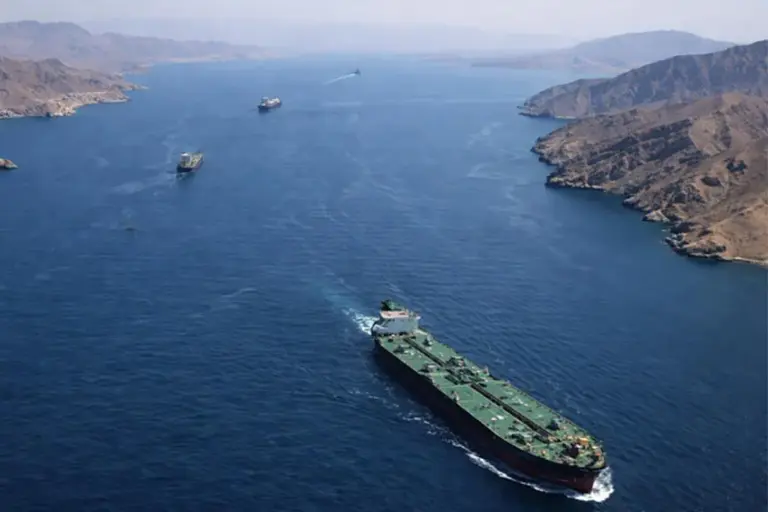
Iran blocked again the Strait of Hormuz on Saturday, hours after it was reopened and with more than a dozen commercial ships transiting through the key waterway.
The tossing and turning over the Strait called into question US President Donald Trump’s optimism the day before that a peace deal to end the US-Israeli war with Iran was “very close.”
Tehran declared the strait open on Friday, following a cease-fire in Lebanon to end Israel’s war with Hezbollah.
This sparked elation in global markets and drove oil prices plummeting, but with Trump maintaining that a US naval blockade of Iranian ports would remain until a deal was reached, Tehran threatened to close the strait again.
Then, late on Saturday morning, citing a statement from military central command, Iranian state TV reported that “control of the Strait of Hormuz has returned to its previous status” and “is under strict management and control of the armed forces,” describing the decision as a response to a continued US blockade.
The declaration came as marine tracking services showed multiple ships rushing through the tight strait, snuggling close to Iranian territorial waters as directed by Tehran and, in some cases, broadcasting their identities as Indian or Chinese in an apparent bid to demonstrate their neutrality.
By 1030 GMT on Saturday, no fewer than eight oil and gas tankers had crossed the strait, while at least as many ships appeared to have turned back and begun to leave the Gulf.
There are only four days left in the two-week ceasefire in the US-Israeli war against Iran, which began on February 28.
Nonetheless, President Trump appeared hopeful that a deal could be reached soon.
He declared Friday to be “GREAT AND BRILLIANT” and praised Pakistan, the discussions’ mediator, in a flurry of social media posts.
Field Marshal Asim Munir, Islamabad’s strong military chief, concluded a three-day journey to Iran on Saturday to secure the peace agreement, during which he visited with Iran’s top leadership.
While Munir was in Iran, Pakistani Prime Minister Shehbaz Sharif traveled to Saudi Arabia, Qatar, and Turkey to advance the peace effort.
Egypt, which has also been involved in diplomatic efforts, appeared optimistic on Saturday, with Foreign Minister Badr Abdelatty stating that Cairo and Islamabad aimed to reach a final agreement “in the coming days.”
Islamabad has emerged as the primary mediator in the war, sponsoring a long session of direct peace negotiations last weekend attended by US Vice President JD Vance.
A second round of talks is scheduled in Pakistan’s capital this week, with envoys attempting to bring an end to the war that began on February 28 between the US and Israel.
Despite the fact that Washington and Tehran were in diplomatic discussions, the allies unleashed a large wave of surprise attacks on Iran, killing Iranian supreme leader Ali Khamenei and many other top officials.
The war quickly extended throughout the region, with Iran targeting US interests in the Gulf and Hezbollah drawing Lebanon into the conflict by shooting rockets at Israel.
Iran’s civil aviation department declared its airspace open again, allowing international flights to traverse Iran via the country’s east, indicating that the two-week ceasefire was still in effect.
Nonetheless, two fundamental issues in the peace talks looked to be unresolved: Iran’s stockpile of near-weapons-grade enriched uranium and the future of the Strait of Hormuz.
Speaking on the phone with AFP on Friday, Trump said “we’re very close to having a deal,” adding that there were “no sticking points at all” with Iran.
Later that day, at a ceremony in Arizona, the president announced that Iran has agreed to send over 440 kilogrammes of uranium enriched to 60 percent, which is close to the amount required for a bomb.
“We’re going to get it by going in with Iran, with lots of excavators,” he said.
However, hours earlier, Iran’s foreign ministry stated that its stockpile, which was assumed to be buried deep under debris by US bombing during last June’s 12-day battle, would not be moved.
“Iran’s enriched uranium is not going to be transferred anywhere,” Iranian foreign ministry spokesman Esmaeil Baqaei told state TV.
“Transfer of Iran’s enriched uranium to the US has never been raised in negotiations.”
Ordinary Iranians, however, were blocked off from the foreign internet, with Netblocks reporting on Saturday that the blackout imposed at the outset of the war had entered its 50th day.