




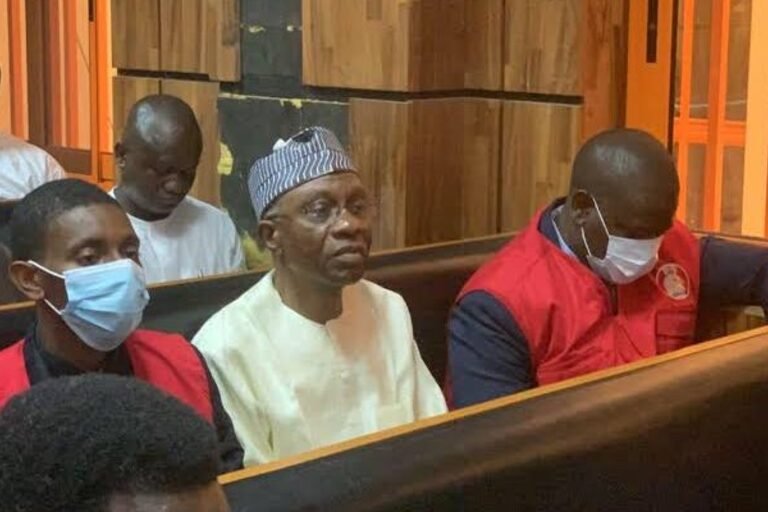
A Lagos State Special Offences Court has admitted a certified copy of a Supreme Court judgment upholding the forfeiture of properties and $2.045 million linked to former Central Bank of Nigeria (CBN) Governor, Godwin Emefiele, in his ongoing trial.
Justice Rahman Oshodi admitted the document as Exhibit L on Friday, November 13, 2026, after dismissing objections raised by Emefiele’s defence team.
The ruling followed an application by the prosecution, led by the Director of Public Prosecutions of the Federation, Rotimi Oyedepo (SAN), to tender the Supreme Court judgment as evidence.
The prosecution presented the document through an Economic and Financial Crimes Commission (EFCC) investigator, Alvan Gurumnaan.
Emefiele is facing a 19-count charge bordering on alleged gratification, corrupt demands and abuse of office involving transactions valued at $4.5 billion and N2.8 billion.
His co-defendant, Henry Omoile, is facing a separate three-count charge bordering on the alleged unlawful acceptance of gifts.
Both defendants have denied the allegations.
Why Emefiele’s defence opposed the judgment
Emefiele’s counsel, Olalekan Ojo (SAN), opposed the admission of the Supreme Court judgment, arguing that the document could not be relied upon to establish criminal liability in the ongoing trial.
He also questioned its completeness, arguing that the copy presented contained only the lead judgment rather than the separate judgments of the other Supreme Court justices.
Ojo further maintained that the judgment arose from non-conviction-based forfeiture proceedings and should not be used to establish the allegations in the criminal case.
Counsel to the second defendant, Adeyinka Kotoye (SAN), aligned himself with the objections, arguing that the document should not be admitted because it was not included in the prosecution’s proof of evidence.
However, the prosecution maintained that the document was a duly certified public record admissible under Sections 102 and 104 of the Evidence Act.
Judge limits use of Supreme Court judgment
In his ruling, Justice Oshodi held that a certified true copy of a Supreme Court judgment was admissible as a public document.
He also relied on previous judicial decisions to dismiss the argument that presenting only the lead judgment made the document incomplete or inadmissible.
However, the judge made an important distinction regarding how the prosecution could use the judgment.
He explained that the document could only establish what the Supreme Court decided in the earlier forfeiture proceedings and could not be treated as evidence for or against any defendant in the ongoing criminal trial.
The ruling means that admitting the judgment does not amount to a finding of guilt against Emefiele or his co-defendant.
Supreme Court upheld forfeiture of $2.045m, seven properties
The judgment admitted by the Lagos court relates to the Supreme Court’s July 17, 2026, decision restoring the final forfeiture of seven properties, $2.045 million and share certificates linked to Emefiele.
The apex court overturned an earlier Court of Appeal decision that had set aside the Federal High Court’s forfeiture order.
The forfeiture order was originally granted by Justice D.I. Dipeolu of the Federal High Court on November 1, 2024, following an application by the EFCC.
The anti-graft agency had argued that there were reasonable grounds to suspect that the assets were acquired through proceeds of unlawful activities.
The forfeiture proceedings were pursued under Section 17 of the Advance Fee Fraud and Other Fraud Related Offences Act, 2006.
EFCC investigator grilled over investigation
Following the court’s ruling, proceedings continued with the cross-examination of EFCC investigator Alvan Gurumnaan.
The investigator told the court that he led a 10-member special operations team responsible for investigating the allegations against the former CBN governor.
During questioning, Gurumnaan confirmed that he personally interviewed former Zenith Bank Managing Director, Ebenezer Onyeagwu.
He acknowledged that obtaining written statements after interviews was standard investigative practice but said he could not immediately recall whether a statement was obtained from Onyeagwu.
The investigator also disclosed that the team interviewed hundreds of people, including CBN officials, commercial bank employees and personnel of other government agencies.
The court adjourned the case for continuation of the trial.