


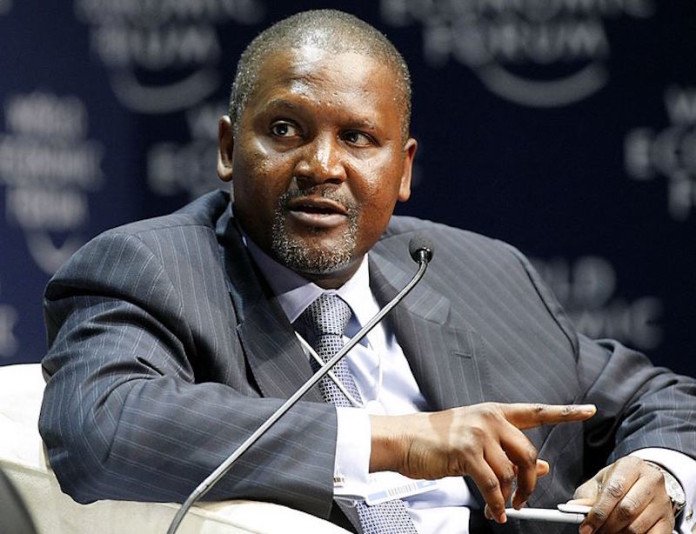
Aliko Dangote, president of Dangote Industries Limited (DIL), has unveiled plans to expand the group’s petroleum products distribution network across Africa, with investments in pipelines, storage facilities and a proposed refinery in Kenya.
The industrialist disclosed the plans during a conversation with David Pilling, a journalist with the Financial Times (FT), outlining investments spanning Kenya, Djibouti, Ethiopia, Cameroon and Namibia.
Dangote said the group had acquired a 25 per cent stake in Kenya’s petroleum products pipeline network as part of efforts to improve the distribution of refined products across the continent.
“Just let me tell you, yesterday, with the support from the President of Kenya, we bought 25 per cent of the pipeline network for the distribution of petroleum products,” he said.
The planned expansion is intended to address supply challenges, reduce transportation bottlenecks and strengthen Africa’s energy security by connecting the Dangote Petroleum Refinery in Lagos with markets across East, Central and Southern Africa.
### Dangote targets East and Southern African markets
Dangote said the group was investing in depots, pipelines and storage facilities to facilitate the movement of petroleum products across several African countries.
In East Africa, the group is developing a distribution corridor linking Djibouti to Addis Ababa, Ethiopia’s capital, supported by tank farms for storing and transporting petroleum products.
He added that a project in Cameroon was nearing completion, while Namibia had been identified as a strategic location for expanding the group’s operations into Southern Africa.
According to Dangote, the group plans to transport refined petroleum products from its Lagos refinery to Namibia before distributing them to other markets, including Botswana and South Africa.
“From our refinery to Namibia is just about four days of steaming,” he said.
The group is also considering a distribution corridor through Zimbabwe and Zambia to establish infrastructure capable of serving multiple countries.
The proposed network would connect the refinery with markets that have historically depended on imported petroleum products and fragmented distribution systems.
### Dangote plans 700,000-barrel refinery in Kenya
Dangote also disclosed plans to establish a refinery in Lamu, Kenya, with a proposed capacity of approximately 700,000 barrels per day.
He said the facility would serve East Africa’s industrial and mining sectors, which require substantial quantities of energy but face challenges accessing diesel and other petroleum products.
According to the industrialist, the refinery would source crude oil from different markets rather than depend exclusively on supplies from Uganda or Kenya.
He said technical assessments of several potential locations informed the choice of Lamu, with deep-water access, marine facilities and adequate water resources among the key considerations.
If developed as proposed, the refinery would form part of Dangote Group’s broader strategy to expand its presence in African energy markets.
Dangote advocates protection for African industries
Dangote warned that allowing imported products to displace locally manufactured goods could undermine employment and industrial development across the continent.
“Exporting our jobs out of the continent, importing poverty into the continent,” he said.
During the conversation, the billionaire argued that African governments should create conditions that enable domestic manufacturers to compete and expand rather than expose emerging industries to unrestricted foreign competition.
Citing developments in the United States and the global automobile industry, he said protecting strategic industries was not exclusive to developing economies but was also practised by major economic powers.
“If America is now saying, no, we are going to protect our industries, who are we in Africa not to protect our own industries?” he said.
Dangote maintained that policies supporting local manufacturing would help African countries reduce their dependence on imported goods and strengthen their industrial capacity.
Dangote budgets $50bn for investments by 2030
Dangote disclosed that his group had budgeted approximately $50 billion for investments between 2026 and 2030.
He described the programme as part of a broader ambition to demonstrate Africa’s ability to execute large-scale industrial projects and encourage more entrepreneurs and investors to participate in the continent’s industrial transformation.
“The legacy we are trying to set up is how do we industrialise our continent?” he said.
He added that Africa’s development would depend on stronger financial institutions, effective agricultural and industrial policies, and improvements to infrastructure that continues to constrain economic growth.
Dangote identifies electricity shortages as major obstacle
Dangote identified unreliable electricity supply as one of the major barriers to industrialisation, particularly in mining and mineral processing.
He said inadequate power supply often prevents African countries from processing their natural resources locally and adding value before exporting them.
According to him, approximately 650 million Africans lack access to electricity, a challenge he said must be addressed to unlock opportunities in manufacturing, employment and economic diversification.
Dangote questioned why a continent with extensive agricultural land, abundant mineral resources and a youthful population continued to experience widespread poverty.
He expressed confidence that Africa’s economic transformation had begun, adding that governments and entrepreneurs were increasingly recognising the need to take responsibility for the continent’s industrial future.