



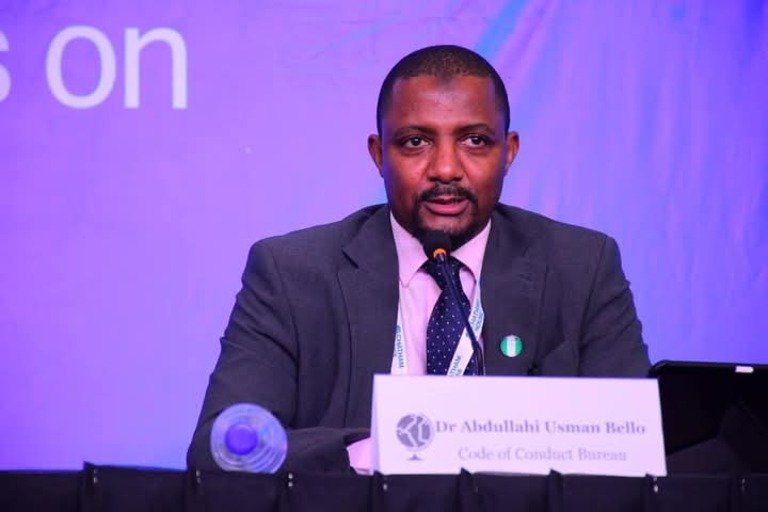
The Chairman of the Code of Conduct Bureau, CCB, Abdullahi Bello, disclosed that the bureau has investigated and verified the assets of more than 20 ministers and 30 permanent secretaries as part of efforts to strengthen accountability among public officers.
Bello made this known in Abuja on Wednesday during a stakeholders’ workshop on anti-corruption and asset tracing, organized by the Human and Environmental Development Agenda alongside the Platform to Protect Whistleblowers in Africa.
Bello stated that the CCB had gone from simply collecting asset declaration forms to now scrutinizing declarations, investigating suspected violations, and prosecuting those who break the law.
“We are not submitting forms anymore. Now, we’re examining the forms, we’re also investigating, and we’re also prosecuting,” he said.
The chairman revealed that the bureau had focused its verification exercise on high-profile public officers.
“We have interviewed and verified the relations of more than 20 ministers, 30 permanent secretaries, 32 health agencies, and other high-profile individuals,” Bello said.
He stated that the bureau invites public officers to its office for face-to-face examination of their records.
“One of the key things that we do is that, once you declare your assets at the beginning of your term, we verify it; then we’ll wait for you at the end of your term, and we’ll also verify it.
“If you see any difference between the beginning and the end that can only be explained by your non-social income, then we investigate you and prosecute you,” he said.
He stressed that the CCB could commence an investigation before the end of an official’s tenure where allegations or intelligence existed.
“But it doesn’t mean that we have to wait for you to finish the office before we can investigate you. If there is any allegation against you, we can also investigate. Or if there is intelligence against you, we can also investigate, he said.
Bello described asset tracing as integral to the bureau’s anti-corruption efforts.
“Asset tracing is not a side issue. It’s where investigation becomes persistent,” he said.
He also mentioned that the CCB had secured convictions and forfeited properties and funds linked to breaches of the code of conduct.
“For the first time in the life of CCB, we have been able to do that,” he said.
He mentioned that the Code of Conduct provisions provided for sanctions, including removal from office, disqualification from holding public office, and forfeiture of assets acquired through breaches.
“If you look at the prohibition of the Code of Conduct, there are three major punishments for Code of Conduct breaches. First, you can be banned from office for 15 years. You can be removed from the office. And then finally, the assets that you acquire from a breach can be forfeited to the government,” he said.
During the workshop, HEDA’s Executive Secretary, Arigbabu Sulaimon, stated that the meeting sought to enhance inter-agency collaboration, intelligence sharing, and the involvement of civil society in the fight against corruption.
Sulaimon stated that the workshop was “conceptualized not merely as a platform for speeches, but as a technical working session” to advance three core institutional objectives.
He mentioned that the first objective was “bridging interagency silos and fostering civic synergy,” stressing the need for effective information sharing among government agencies and civil society organizations.
“Realizing full accountability requires seamless real-time intelligence exchange among our primary military and enforcement bodies,” Sulaimon said.
He mentioned that civil society organizations could contribute to investigations through grassroots monitoring and open-source intelligence.
“Importantly is forging strong operational pipelines with civil society organizations whose grassroots tracking and open-source intelligence tools provide invaluable leads for criminal investigation,” he said.
Sulaimon also appealed for greater use of the Proceeds of Crime Act and the Code of Conduct Bureau’s statutory mechanisms in tracing and recovering illicit assets.
“Operationalizing the Proceeds of Crime Act, POCA, is essential to ensure that confiscated assets are not only effectively recovered but also managed and disposed of with absolute public transparency,” he said.
He also called on the authorities to make asset declaration a more effective tool for detecting illicit enrichment and abuse of public office.
“Furthermore, we must transform the code of conduct we use after the declaration process from a routine and restricted exercise into a dynamic, verifiable mechanism for detecting early signs of illicit enrichment and public office abuse,” Sulaimon said.
Speaking on whistleblower protection, the HEDA executive secretary said greater safeguards were needed to encourage individuals to provide information on corruption and other crimes.
“Whistleblowers remain the single most effective catalyst for uncovering criminal crimes. Yet, without robust statutory protections and safe reporting mechanisms, courageous individuals remain vulnerable to retaliation,” he said.