


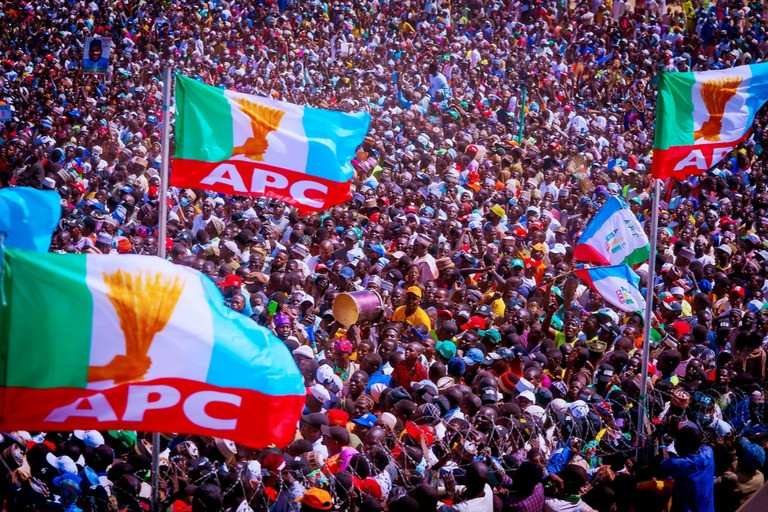
The All Progressives Congress (APC) National Assembly primary election in Benue State has left the party more divided, with allegations of electoral manipulation, candidate imposition, and internal betrayal threatening ongoing reconciliation efforts ahead of the general elections.
Despite a well-attended reconciliation meeting in Makurdi a few weeks ago, there were hints that peace remained elusive in the party.
At the conclusion of the meeting, the parties emerged with opposing interpretations of the resolutions achieved.
Governor Hyacinth Alia disagreed with the Secretary to the Government of the Federation (SGF), Senator George Akume, who claimed that President Bola Tinubu’s directive on the Benue APC crisis was to grant automatic tickets to all serving members of the state and National Assembly, including the governor, through consensus.
According to the governor, both the APC National Chairman, Professor Nentawe Yilwatda, and the president have stated unequivocally that no serving elected official will receive automatic tickets during the primaries.
“The issue of automatic tickets is beyond me and the SGF because the national chairman of the party and the president had declared that there would be no automatic ticket. The submission of the SGF was only a prayer,” Alia said.
Although the reconciliation meeting resolved to form an ad hoc committee to further reconcile the disgruntled factions, the move was hampered by the distribution of a leaked communiqué in which the issue of automatic tickets was supposedly included.
The Deputy Governor, Sam Ode, who also chaired the communiqué drafting committee, indicated that the group just created a draft communiqué for the governor and SGF to study and approve.
He emphasized that the committee does not deliberate on or approve automatic tickets for national or state assembly members.
“At no time in our communiqué did we mention automatic tickets for National Assembly members, State Assembly members, or anybody for that matter.
“Whoever mischievously sponsored the publication currently in circulation is doing a great disservice to the governor of Benue State, Rev. Fr. Hyacinth Alia; the secretary to the government of the Federation, Senator George Akume; the APC family; as well as the spirit of the ongoing reconciliation and peace efforts,” the deputy governor said.
According to sources in government, the governor’s camp was outraged by the leaked communiqué, which they said was arranged by one of the SGF’s serving senators in order to alter public perception.
There were also unconfirmed rumors that the governor’s camp had pledged to prevent lawmakers loyal to the SGF, particularly members of the National Assembly caucus, from obtaining return tickets during the primaries.
Whether or not the allegation was genuine, the results of the National Assembly primaries appeared to back up the charge, as six members of the House of Representatives and two senators thought to be loyal to the SGF lost their quest to earn party tickets.
For the time being, many party members are unsure what the primaries will mean. Although the state has stayed tranquil, political tension and anxiety continue to pervade the atmosphere.
While the winners have generally abstained from public celebrations, the losers are still debating the outcome and what it may mean for their political future.
Tension has risen in Benue State following the APC National Assembly primaries, with many party members and political observers characterizing the process as profoundly flawed.
Many stakeholders believe that the once-unified and energetic ruling party has become severely fragmented, with accusations of manipulation and candidate imposition dominating political conversations across the state.
One of the commercial drivers contracted to take security personnel and poll materials to a local government area in Benue North-East Senatorial District, speaking on the condition of anonymity, raised concern over the exercise’s conduct.
According to him, “As soon as we arrived at the local government headquarters, our first point of call was the Divisional Police Office. From there, we proceeded to the council secretariat, where the election materials were distributed to some persons waiting for us. They immediately moved into one of the offices where figures were allegedly allocated to aspirants.”
The driver claimed that the outcome of the primaries appeared predetermined, claiming that the entire process was coordinated by the state working committee loyal to the governor.
“Right from the party secretariat, which has remained under the control of the governor’s exco, the election materials were handed over to officials loyal to the governor. The primary election committee also worked closely with them. All the local government returning officers were appointed by the Benjamin Omale-led exco put in place by the governor,” he alleged.
Tony Ogah, a political expert in the state, also criticized the exercise, calling what happened during the primaries “a shame.”
He contended that direct primaries, when correctly conducted, remained one of the most democratic ways of candidate selection.
“Let me first correct the impression created by some people who condemned direct primaries because of what happened during this exercise,” he said.
“To me, direct primaries hold the key to unlocking the power of the masses. They also help to revive party loyalty and reduce the influence of personal interests.
“Even if the powers that be wanted to reward loyalty, it should have been done in a manner that would strengthen our democratic system.”
Ogah noted that the APC also used direct primaries in the state’s 2023 elections, with party members publicly queuing behind their favored candidates.
“But during this primary election, if you moved around the capital city as a journalist, where exactly did you witness voting taking place throughout the National Assembly primaries?” he asked.
“It was the same situation across the state. Election materials were allegedly hijacked and taken either to local government secretariats or private residences of political godfathers, where results were simply allocated to preferred aspirants.”
Ogah cautioned that the alleged imposition of candidates had already sparked animosity inside the party and could harm the APC’s chances in the upcoming general election if not addressed correctly.
Also speaking, a party stakeholder in the state who identified only as Chief Akeh expressed concern about the primaries’ conduct, albeit he praised party members for keeping the peace during the process.
According to him, what happened during the recently ended State and National Assembly primaries represented the character of politics in the country, but he added that the situation could have been improved if party members had been free to choose their favorite candidates.
“Actually, the primary election has left a bitter taste in our mouths, but one thing I appreciate is the peaceful manner in which the other camps reacted to the outcome of the exercise,” he said.
“Instead of resorting to violence, they chose the path of peace by taking their grievances to the appeal panel. I only hope the panel will be fair enough to arrive at the truth.
“Because if there was truly an election and the people voted you out, then you would know outrightly that you were rejected. But the primaries were allegedly marred by several irregularities, ranging from the hijacking of election materials to the non-conduct of elections in many council wards across the state,” Akeh argued.
Similarly, Daniel Ihomun, the State Publicity Secretary of the Agada-led APC executive committee who is loyal to the SGF, revealed that more than ten contenders from their camp who lost the National Assembly primary had filed a plea with the party’s appeal panel over alleged irregularities.
According to him, “The election was marred by electoral fraud, and that has the potential to destroy the ongoing reconciliation efforts because once people are denied the opportunity to exercise their franchise, they are inviting trouble.
“Our party was built on the principles of fairness and democratic values, but when things are not done properly, it could lead to chaos and serious crisis.
“We hope the party leadership will correct these mistakes ahead of the general elections. It is one thing to secure a party ticket and another thing entirely to win the general election.”
Ihomun also voiced concern that “strangers and political opportunists” had reportedly taken over the party from its legacy members, warning that this development may destroy the APC if not addressed immediately.
Meanwhile, the APC’s State Publicity Secretary, Benedict Yawe, of the Benjamin Omale-led executive committee and a supporter of Governor Hyacinth Alia, praised the governor and the National Assembly Primary Election Committee for the smooth conduct of the primaries.
According to Yawe, the exercise was conducted in a peaceful and transparent manner, which he owed to the leadership of Governor Alia and the state party chairman, Benjamin Omale.
“The National Assembly Primary Election Committee did very well. They were transparent during the distribution of election materials and made it clear that the materials were not meant for anybody in particular but for all party members,” he said.
“For the public to know that the election was free and fair, there was no report of violence anywhere before, during, or after the National Assembly primaries. We expect the same peaceful atmosphere during the State Assembly and governorship primaries.”
Yawe also ascribed the peaceful political atmosphere observed throughout the exercise to Alia’s vow, which he claimed promised to offer an equal playing field for all contestants to test their popularity at the polls.