
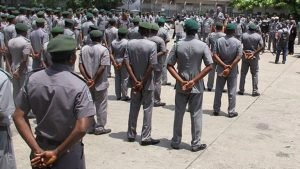




The Nigeria Customs Service has stated that candidates whose names were included in its published recruitment list are not automatically assured of appointment, clarifying that final screening is still underway before successful applicants are admitted for training.
This clarification came after complaints from some candidates who said they had passed the Computer-Based Test, physical examinations and initial screening, accepted their appointments via the official recruitment portal and found their names listed as successful candidates, yet had still not received invitations for training set to begin on Friday.
According to a report by SaharaReporters, the candidates affected include over 500 applicants who said their status had been left uncertain after training invitations reportedly ceased on Monday.
Some of the candidates said they had quit their previous jobs and incurred other costs after assuming their appointments were secured.
However, the Customs spokesman and Deputy Comptroller of Customs, Abdullahi Maiwada, told the press on Wednesday that having a candidate’s name published did not constitute a final appointment into the service.
Maiwada said candidates must clear the physical screening and other requirements before they can be admitted into the training college and ultimately commissioned as officers.
“I will start my response first with a question. Did anyone who complained to you inform you that they have been issued an appointment letter? So that means the process is still ongoing. Secondly, the essence of screening is to have a physical examination of successful candidates.
“Let me explain so that you will have proper context. The essence of screening is either for candidates to be screened in or screened out, and they are just simple issues. It is either you have not met the criteria to be offered an appointment letter to Customs or to be ushered into training college. If anyone fails this, they will be dropped,” he said.
The spokesman stated that age, academic qualifications, medical fitness, and drug use were among the criteria that could decide whether a candidate advanced to the next stage.
He explained, “Those criteria are simple. Age is very important. If your age is above the threshold, you will be disqualified. If there are inconsistencies in your credentials, you will be disqualified. If there are forgeries detected, you will be disqualified.
“If we see you with drugs, any element of drugs except tobacco and beer, you will be disqualified. If you have medical issues that wouldn’t warrant you to undergo that rigor, you would also be disqualified.”
Maiwada emphasized that gaining admission into the training college alone would not qualify a candidate as a Customs officer, noting that applicants must complete the training successfully and meet academic, physical, and character requirements before being commissioned.
He said, “The fact that your name came out and you are invited for screening doesn’t qualify you to be a customs officer. Even with that, you are going for training. And you will go for the training. It is when you pass the requirements that you will be commissioned as an officer. Anything before that, you are still not an officer.
“Someone can go to the Nigerian Defence Academy and still fail. It is not everyone who comes out who passes or is a flying lieutenant. And even if you find yourself in training college, you are still not a customs officer. Until the day you pass out successfully and you are able to withstand all the rigors.
“Academic exercises will be done, and you must come out well in character and learning. Exams will be conducted.”
The spokesman stated that the service could not justify spending public resources to train candidates who had already failed basic eligibility requirements. He said drug screening was particularly important because the Customs Service conducts annual drug tests for serving officers, regardless of rank.
“If someone is into drugs and he is disqualified, do we have to waste our resources taking him to training college before disqualifying him? No! These are criteria that are so simple. You have forgery and the like, and you want to be allowed into the system.
“If you see what we saw with medical records, you will be scared for this country. The rate at which boys are into drugs—you will be scared. Is this the future? The service runs drug tests for every officer every year, no matter your ranking. So if we can do that to persons in the system, what do you think we would do to persons outside it?” Maiwada said.
The continuing dispute is tied to the Nigeria Customs Service’s 2024/2025 recruitment drive, which kicked off with an advertisement that was published on December 27, 2024.
The Service announced 3,927 openings across the Superintendent, Inspectorate, and Customs Assistant cadres, drawing 573,680 applications.
Following multiple rounds of screening and verification, 3,852 candidates were chosen, which amounts to just 0.67 percent of the applicants, or roughly one successful candidate out of every 148.
The candidates who made it through consisted of 1,275 superintendents, 367 inspectors, and 2,210 customs assistants. The service subsequently carried out medical documentation and physical screening, then invited those who passed the next stage to basic training set to start on October 9, 2026, at the Customs Training College.
Maiwada’s explanation indicates that candidates whose names showed up on the published list could still face additional verification before they are given final appointment letters, go through training, and are ultimately commissioned as Customs officers.