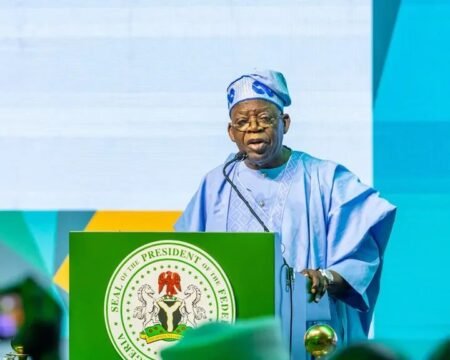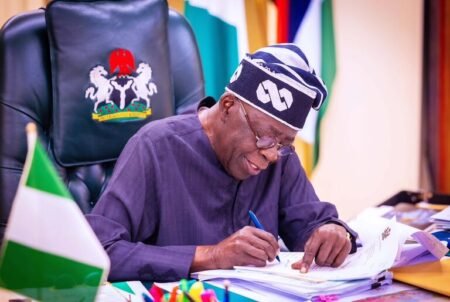



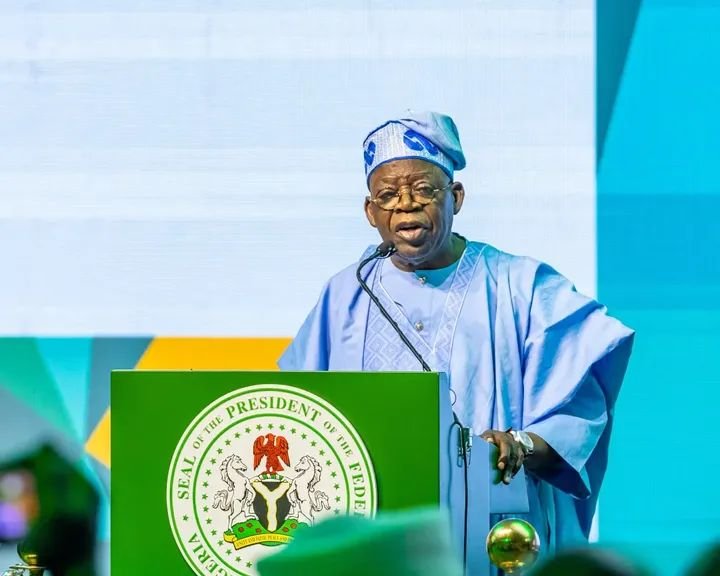
President Bola Tinubu declared on Thursday that the toughest stage of his economic reforms had passed, with the nation now shifted from an “age of reform” to an “age of prosperity,” as he told Nigerians in his Independence Day broadcast, while also warning politicians who advocate a return to fuel subsidies ahead of the 2027 general election.
Commemorating Nigeria’s 66th Independence anniversary, Tinubu used the nationwide address, themed “From Reform to Prosperity,” to defend the removal of the petrol subsidy and the unification of the naira exchange rate, comparing the country to a cancer patient who opted for painful treatment rather than the “morphine” of denial that his predecessors had administered.
“Nigeria was like a sick patient who receives the terrible news that he has cancer,” the president said. “His doctor explains that the treatment will be difficult and painful, but that it offers a strong prospect of recovery. The patient has a choice. He can begin treatment, endure its discomfort, and fight the disease. Or he can ask only for morphine, dull the pain, and leave the cancer to spread.
“For too long, Nigeria’s leaders chose morphine while praying for a miracle that never came.”
In a clear jab at opposition figures among them former Vice President Atiku Abubakar, who in recent weeks has promised to bring back a “targeted” petrol subsidy if he wins in 2027 Tinubu called on Nigerians to reject what he described as a “siren song” urging a return to subsidy payments.
“Now, as certain influential but regressive voices would have us abandon the treatment and return ourselves to the abuse of addictive subsidies, we must resist their siren song,” he said. “We must remember why we began this journey and how far we have already come.”
The president maintained that his administration’s reforms were not the cause of Nigeria’s economic weaknesses; rather, they tackled issues that earlier governments had left unaddressed. “The weaknesses in our economy were not brought about by our reforms. They faced up to them,” he stated.
Tinubu remarked that three and a half years into his tenure, the outcomes of the reforms were “undeniable.” He informed Nigerians that the economy had expanded by over four percent in 2026, with the oil and non-oil sectors both fueling what he called a renewed era of steady growth.
According to him, oil theft had dropped, inflation had decreased considerably from its peak, foreign reserves had been restored, and the foreign exchange market had become stable.
He also revealed that in 2025, Nigeria earned its highest-ever revenue from non-oil exports, surpassing $6bn.
“This is real money being made by real Nigerian businesses,” he said, adding that international observers, journalists, NGOs, and multilateral institutions had all concluded that the reforms strengthened Nigeria’s economic stability and resilience and that foreign direct investment continued to rise.
Announcing a shift in his administration’s economic messaging, Tinubu stated that the “central economic task” facing the country had now moved from correcting Nigeria’s course to achieving “shared and widespread prosperity.”
“The emergency treatment is over. The foundation has been repaired,” he said. “For three years, our overriding purpose was to correct our nation’s course. Now, our purpose is simple: shared and widespread prosperity.”
He framed prosperity in personal terms instead of macroeconomic statistics: a farmer able to cultivate safely and earn a decent return, factories with dependable power, businesses with access to credit, young people engaged in productive work, and families able to afford food, transportation, and education.
Regarding the cost of living, which continues to be a major concern for Nigerian households, Tinubu stated that his government’s priority was to reduce the cost of producing and moving the goods Nigerians consume.
He outlined plans to expand mechanized irrigation and dry-season farming, enhance access to seeds and fertilizer, deepen agricultural mechanization, and invest in storage, transportation, roads, railways, and ports linking farms and factories to markets.
“Our logic is simple,” he said. “When a farmer produces more cheaply, when fewer crops are lost between the farm and the market, when a manufacturer spends less on electricity, when a truck reaches its destination faster, and when the business environment fosters fair competition, all those savings will ultimately find their way into the price of goods in the market.”
The president stated that his administration would put “jobs, enterprise, and industrial growth” at the heart of future policy, promising to use domestic gas to fuel new industries, bring factories back to life in Nigeria’s industrial hubs, extend digital connectivity to underserved communities, and invest in the skills that employers need.
“I want to see more Nigerians making things,” he said. “I want to see more Nigerian farms feeding our cities and supplying our factories. I want to see Nigerian businesses selling Nigerian goods to the whole world. I want young Nigerians building unicorns and creating opportunities for others here at home.”
Recognizing that millions of Nigerians “cannot wait for tomorrow,” the president stated that his administration was boosting direct assistance to the poorest households and upgrading the National Social Register so that aid reaches those who need it most.
He pointed to the Nigerian Education Loan Fund (NELFUND), which he said enables children from low-income families to pursue higher education irrespective of their parents’ financial situation, and CREDICORP, which offers working Nigerians consumer credit to obtain vehicles, solar systems, and other assets without having to save for years beforehand.
He noted that salaries and pensions had been paid “on time and in full” since 2023 and that the national pension program had been overhauled to serve retirees and the vulnerable.
“These programs are not substitutes for prosperity. They are a bridge,” he said. “Our objective is not to manage poverty more efficiently. We will defeat it.”
Tinubu wrapped up the address with a biblical reference, likening Nigeria’s economic recovery to Israel’s departure from Egypt.
“Nigeria has set itself back on the right path. We have crossed our own Red Sea. This is no moment to glance backward,” he remarked.
“Our destination is within reach. Our foundations remain solid. Our path is unmistakable. Therefore, let us keep moving ahead. With no turning back.”
The President’s remarks come amid ongoing public outcry over the soaring cost of living and intensifying political maneuvering before the 2027 election, where subsidy policy has already become a point of contention between the governing All Progressives Congress and opposition contenders, among them Atiku, whose camp has drawn criticism from the Presidency for wavering on the restoration of petrol subsidies.