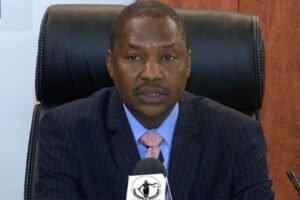




Former Attorney-General of the Federation and Minister of Justice Abubakar Malami, SAN, has welcomed Nigeria’s triumph in the Mambilla Hydroelectric Power Project arbitration while dismissing claims that he struck a corrupt deal with Sunrise Power promoter Leno Adesanya.
Malami’s stance was laid out in a statement released on Tuesday by his Special Assistant on Media, Mohammed Doka, after the International Chamber of Commerce arbitration tribunal threw out the claims filed by Sunrise Power and Transmission Company Limited against Nigeria.
In its 616-page final award issued in Paris on September 16, 2026, the ICC tribunal dismissed Sunrise’s claims relating to the Mambilla project and directed the company and Adesanya to repay Nigeria a substantial share of its legal costs.
Yet accounts of the award indicated that the tribunal reached adverse conclusions about how Malami handled a settlement agreement with Sunrise, including an alleged corrupt arrangement between him and Adesanya.
In response, Malami noted that the proceedings were commercial arbitration rather than a criminal trial, emphasizing that the award must not be portrayed as a criminal conviction.
“The proceedings were commercial arbitration proceedings between parties to a dispute. They were not a criminal prosecution of Abubakar Malami, SAN, and the award does not constitute a criminal conviction of him,” the statement said.
He did, however, concede the gravity of the findings reported from the award, stating that they ought to be weighed against the full documentary and evidentiary record.
“Those matters should not be ignored, trivialized, or answered by speculation,” the statement added.
Malami also tried to set the controversy in historical context, contending that the dispute over Sunrise and the Mambilla project predated his time as Attorney-General by several years.
As he told it, Sunrise became involved in the proposed project in 2003, and successive administrations and attorneys-general grappled with contractual disputes involving the company.
He stated that former AGF Michael Aondoakaa had examined the dispute before his own tenure and advised an amicable resolution, while the Federal Government signed a General Project Execution Agreement involving Sunrise and Sinohydro in November 2012.
“The relevance of this history is straightforward: Malami did not create the Sunrise dispute, introduce Sunrise to the Mambilla project, or originate the Federal Government’s attempts to settle the controversy.
“He inherited a longstanding dispute that had traversed previous administrations, attorneys-general, ministries, and contractual arrangements,” the statement said.
The former AGF stated that his participation came about through governmental and presidential procedures, which included a directive relayed by the then Chief of Staff to President Muhammadu Buhari in April 2016 regarding the settlement of disputes tied to the Mambilla project.
According to him, the Ministry of Justice’s function was mainly to guide the Federal Government on its legal exposure and on possible approaches to resolving the dispute.
Malami went on to clarify that by 2019, the still-unresolved Sunrise dispute was seen as a barrier to financing talks about the Mambilla project, among them discussions with China Exim Bank.
He noted that during negotiations in London in November 2019, Sunrise first asked for $500m as a full and final settlement, whereas Federal Government representatives offered $100m in response before a figure of $200m came up.
“The governmental calculation was whether an asserted multibillion-dollar exposure, continuing litigation, financing difficulties, and delays to the Mambilla project could be brought to an end through a substantially smaller negotiated settlement,” he said.
Malami further emphasized that former President Buhari ultimately declined to approve the proposed $200m settlement.
He stated that on April 20, 2020, Buhari made it clear the Federal Government lacked the $200m needed to pay Sunrise, a stance he said was conveyed to the company on April 22, 2020.
He went on to say that a later request for presidential approval in January 2021 was likewise turned down, with Buhari writing, “Not approved.”
Malami contended that his later actions should also be taken into account, noting that he directed federal government lawyers to oppose Sunrise’s bid to enforce the settlement once the president refused to approve payment.
“Malami did not simply direct that Sunrise be paid regardless of the president’s position,” the statement said.
“When Sunrise asserted that Nigeria was consequently in default… Malami instructed counsel representing the Federal Government to resist Sunrise’s attempt to have the settlement terms adopted or enforced against Nigeria and to preserve the Federal Government’s legal position.”
Speaking on the tribunal’s reported finding of a corrupt arrangement between him and Adesanya, Malami categorically denied the allegation.
“Malami rejects any suggestion that his official actions were undertaken pursuant to a corrupt agreement or in exchange for personal financial benefit,” the statement said.
It further stated that the claim ought to be assessed in light of the full evidentiary record, including whether Malami ever obtained money or any other financial benefit from Sunrise, Adesanya, or any related entity.
The statement also pointed to reports indicating that Adesanya said he had audio or video recordings supporting his allegations, yet those recordings were never brought before the tribunal.
“Where allegations of this gravity are made, the existence, non-production, authenticity, and contents of any claimed recordings are matters of obvious evidentiary importance,” Malami said.
Yet the tribunal’s reported conclusions stated that it uncovered evidence of a corrupt arrangement involving Malami and Adesanya, and media accounts likewise noted that the tribunal weighed evidence that included communications between the two.
Even with the controversy over the former AGF’s involvement, Nigeria obtained the result it was pursuing in the arbitration.
According to the Federal Government, Sunrise had claimed $680m plus interest in one arbitration and over $2.7bn in a separate dispute tied to the Mambilla project.
The tribunal turned down Sunrise’s claims and likewise rejected its request for $400m stemming from the settlement agreement and an alleged default payment. It additionally directed Sunrise and Adesanya to repay Nigeria’s legal costs.
In welcoming the award, President Bola Tinubu called it a removal of a major legal hurdle to the long-delayed Mambilla project, and he praised the Federal Ministry of Justice, the defense team, and the other witnesses who took part in the case.
Malami expressed satisfaction that Nigeria’s financial interests had been safeguarded.
“Nigeria’s victory should be welcomed, and findings concerning the conduct of former public officials should be carefully examined and answered on the evidence,” he said.
He continued that a fuller response to the tribunal’s individual findings would come once his office had reviewed the complete award and the accompanying records.