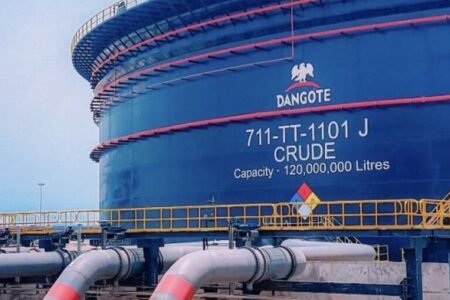




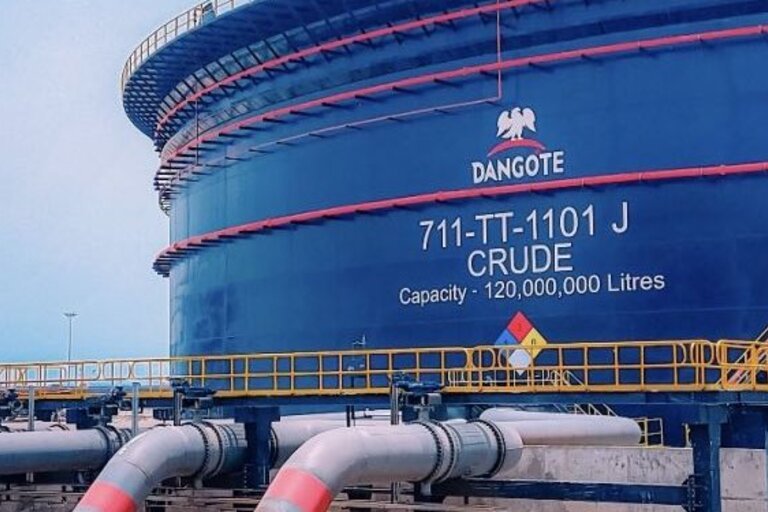
Dangote Petroleum Refinery has set the ex-depot price of Premium Motor Spirit (petrol) at $0.779 per litre, announcing a new pricing framework that also hiked benchmark rates for diesel and aviation fuel after the switch to dollar-denominated transactions.
This signals the end of naira payments for the purchase of refined goods, which began when the naira-for-crude agreement went into effect on October 1, 2024.
The initiative also represents a significant shift in the refinery’s commercial operations, potentially reshaping price dynamics in Nigeria’s deregulated downstream petroleum industry, where Dangote has emerged as the country’s top supplier of refined petroleum products.
The new prices, which took effect on Monday, place Automotive Gas Oil (diesel) at $1.087 per litre and Aviation Turbine Kerosene at $0.942 per litre, while coastal deliveries of petrol were fixed at $1,044.62 per metric tonne.
The announcement, endorsed by the refinery’s Group Commercial Operations, stated, “In reference to our email dated July 9, 2026, concerning the shift from Naira to United States Dollars, please be advised that all released Naira Coastal and Gantry PFIs/Deal Recaps are now void, and no payments should be processed against them.
According to the updated pricing structure, petrol available at the gantry will be priced at $0.779 per litre, diesel at $1.087 per litre, aviation fuel at $0.942 per litre, and coastal PMS supplies will be priced at $1,044.62 per metric tonne.
The firm, nonetheless, specified that the updated pricing structure does not impact liquefied petroleum gas. “The refinery stated that this switch to USD does not pertain to LPG transactions.”
Observations from our correspondent suggest that the new dollar-based pricing mirrors the refinery’s current commercial pricing model and aims to synchronise petroleum product sales with the currency employed in obtaining a large part of its crude oil supply.
Sources acquainted with the development stated that the refinery deemed it essential to implement a consistent pricing structure following an increasing disparity between the currency used to purchase crude oil and the currency in which refined products were sold.
An official remarked that the Dangote refinery is now obtaining a much greater portion of its crude oil from the Nigerian National Petroleum Company Limited through dollar-based supply agreements, while a considerable amount of its refined products remains sold domestically in naira.
The source indicated that the discrepancy had heightened the refinery’s vulnerability to foreign exchange risks.
Clarifying the reasoning for the action, another source mentioned, “The Dangote refinery is receiving fewer naira-denominated crude cargoes from NNPCL compared with dollar-denominated cargoes, while a larger volume of its petroleum products has been sold in naira. The resulting currency mismatch, combined with volatility in international crude oil prices and continued exchange-rate uncertainty, made it necessary to migrate product sales to dollars.”
The ruling is anticipated to have a substantial impact on petroleum marketers, many of whom obtain goods directly from the refinery for national distribution. It might also have an impact on downstream gasoline pricing, depending on changes in the foreign currency market and worldwide crude oil prices.
The refinery had previously accepted naira-denominated transactions as part of the federal government’s domestic crude supply plan, which provided local refiners with crude oil in naira to enhance domestic refining, ease pressure on foreign exchange demand, and stabilise fuel prices.
However, the agreement has encountered implementation difficulties in recent months, with industry players stating that a rising share of oil shipments has returned to dollar-based transactions.
The new move highlights Nigeria’s downstream petroleum sector’s persistent foreign exchange difficulties, despite continuing attempts to strengthen domestic refining and reduce reliance on imported fuels. It also raises new issues about the government’s naira-for-crude programme and its influence on local petroleum prices.
The new dollar benchmark will now be used as a reference price for marketers purchasing products directly from the refinery, though the final retail pump price of petrol will be determined by the current naira-to-dollar exchange rate, logistics costs, transportation margins, regulatory charges, and marketers’ operating expenses.
Pump prices have changed in recent months in reaction to changes in crude oil prices, foreign exchange rates, and supplier rivalry, with industry players keenly following Dangote Refinery’s pricing choices given its rising influence in the local gasoline market.