




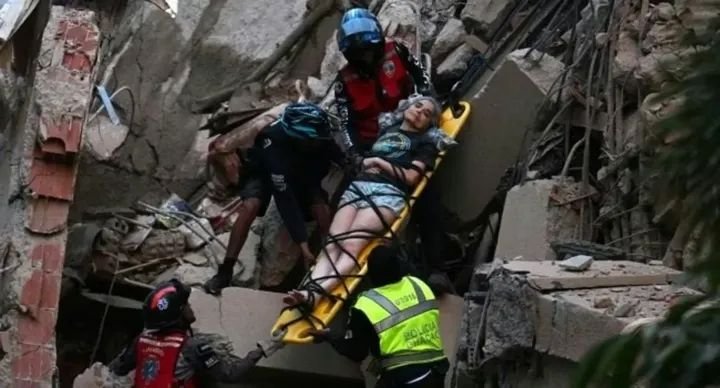
The World Health Organization (WHO) raised alarm on Tuesday about probable disease epidemics in Venezuela, where local healthcare services have been overburdened by devastating earthquakes.
“The health services are under extreme pressure now, with facilities operating beyond their capacity,” spokesman Christian Lindmeier told a press conference in Geneva, noting the surge in trauma cases.
By the current official tally, around 1,700 are dead, and 5,000 are injured, with no governmental word on the number of missing. Other estimates put them in the tens of thousands.
The WHO also stated that there were issues in properly registering casualties and tracking missing people following Wednesday’s 7.5- and 7.2-magnitude earthquakes.
“There’s an increased risk now of outbreaks of vaccine-preventable diseases” such as measles and diphtheria, said Lindmeier, due to low pre-earthquake vaccination coverage, as well as yellow fever, and other vector- and water-borne diseases, including malaria, dengue, chikungunya and Zika.
He said Venezuela’s interim president, Delcy Rodriguez, confirmed that the twin earthquakes had hit 38 hospitals.
As of Saturday, the WHO had collected data from 21 health facilities in Caracas, La Guaira, Miranda, and Falcon.
According to Lindmeier, three of them are in critical condition, six have structural damage or are only partially functional, and the rest are operational but under “significant strain.”
“Preliminary findings reveal chaotic service delivery and patient flow, marked by overcrowding; growing surgical backlogs, especially in trauma, orthopedics, and neurosurgery; breakdown in biosafety measures; and severely stressed staff,” he said.
“Critical gaps include the collapse of forensic and morgue services and inadequate casualty registration and tracking of missing persons.”
The UN refugee agency, UNHCR, has issued a warning about community tensions in quake-hit areas due to limited aid access.
The agency requires an estimated $14.85 million to provide core relief items and temporary shelter support for 30,000 earthquake-affected people over the next six months.
Doctors Without Borders (MSF) is also planning assistance for thousands of homeless individuals.
“As the acute search-and-rescue phase comes to an end, both the number of people killed and the needs of survivors continue to rise.”
It stated that psychological support services were being expanded due to the “extremely high” demand in this subject.