




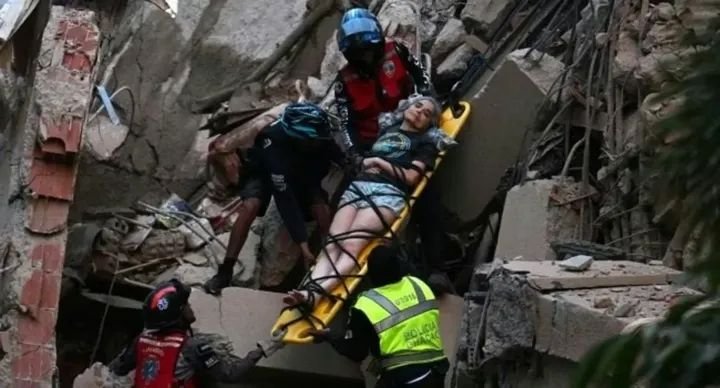
The death toll has risen to 188 in Venezuela, with more than 1,500 injured after two powerful earthquakes struck in quick succession, causing widespread destruction across the country’s northern region and triggering a major humanitarian emergency.
According to authorities in Venezuela, more than 200 people remain trapped beneath collapsed buildings, while rescue workers continue search-and-rescue operations in affected communities.
The earthquakes, which struck late on Wednesday, severely impacted the capital, Caracas, and the neighboring coastal state of La Guaira, where dozens of buildings collapsed, Chronicle NG reports.
Officials stated that at least 250 structures were damaged, with more than 100 buildings reportedly destroyed in La Guaira alone.
Acting President Delcy Rodríguez called the disaster a tragedy, adding emergency personnel were engaged in extensive rescue efforts across the impacted communities.
Key infrastructure suffered devastation from the earthquakes, leading to power outages, ruptured water pipes, and severe communication issues.
Parts of Caracas remained without power on Thursday, and water distribution was disrupted in many northern regions.
Due to significant damage, Simón Bolívar International Airport was closed, and authorities suspended train and metro services for rescue efforts. Schools in affected areas were forced to close for the remainder of the week.
Reports from hospitals and rescue centers reflected the enormity of the calamity.
At the Universidad Central de Venezuela clinic in Caracas, family reported that 10-year-old Efraín Lucena had been rescued from a fallen building in La Guaira and was in stable condition.
Family members claimed doctors were evaluating significant damage to one of his legs and deciding whether amputation was necessary.
According to family members, the boy’s mother managed to get him through a window to escape before becoming stuck in the rubble and dying. Another family member was still missing as rescue efforts continued.
Rescue activities have been exacerbated by Venezuela’s long-standing infrastructure issues, such as intermittent energy supply, declining public services, and limited healthcare resources.
Residents in some of the most severely affected villages described crawling through wreckage themselves in search of survivors, claiming a limited emergency response in the immediate wake of the catastrophe.
Families and neighbors helped with rescue attempts in various spots as they looked for loved ones trapped beneath collapsed structures.
According to experts, the earthquakes’ impact was exacerbated by the fact that they happened so close together and struck a region with geological features that increased ground shaking.
The US Geological Survey warned that many buildings in the impacted area were built with materials that were particularly susceptible to earthquake damage, increasing the likelihood of collapse and contributing to the high mortality toll.
The densely populated neighborhoods of Caracas and La Guaira were particularly hard struck, with residential towers, business buildings, and residences reduced to rubble.
Authorities were also concerned about informal hillside communities, where structures are generally more susceptible to seismic activity.
International assistance has begun to mobilize, with Venezuela saying that rescue teams and humanitarian aid are anticipated from a number of nations, including the United States, Mexico, Brazil, El Salvador, Dominica, and Qatar.
The death toll is expected to grow as emergency workers get access to severely damaged areas and continue to look for survivors trapped beneath collapsed structures.