

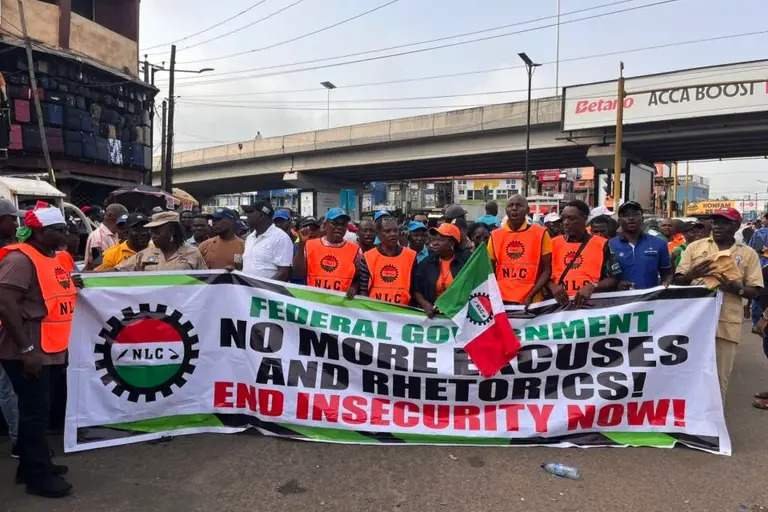
The Nigeria Labour Congress (NLC) and its affiliates staged nationwide protests on Wednesday concerning the increasing insecurity in the nation.
The union announced a national demonstration for December 17, referencing what it labeled as the nation’s “deteriorating security situation.”
In a bulletin sent to all state councils on December 10, following its National Executive Committee meeting on December 4, the union denounced the widespread actions of bandits and kidnappers throughout the nation.
It highlighted the abduction of female students from a boarding school in Kebbi State on November 17 and expressed anger over the removal of security forces from the school just prior to the event.
The union instructed all its affiliates and state councils to “completely mobilize” workers and civil society for the demonstration.
In a final attempt to stop the demonstration, President Bola Tinubu met with the leadership of the NLC and several governors, including Imo State Governor Hope Uzodimma, on Tuesday night.
Joe Ajaero, the president of NLC, informed reporters on Wednesday that Congress leaders would meet with the president again by January to discuss the financial insecurity of Nigerian workers.
Ajaero stated that the engagement the Labour had with the Federal Government was aimed at cancelling the planned protest, adding that the workers who were poorly paid and inadequately fed were more likely to face deeper challenges.
“The action continued this morning (Wednesday). We are rounding off now. We will take back whatever we discussed with them to our members.
“The attitude of meeting on the day or eve of any action is not rocket science.
“However, Mr. President was emphatic that the issue of insecurity will be a thing of the past very soon. He said he’s taking extra steps to take care of it.
“We equally talked about financial insecurity because a worker who is not well fed and not well paid will have even more problems than those who are well fed and well paid.
“Mr. President said he has put Nigeria on the map of prosperity, and we agreed that we’re going to meet in January to look at some grey areas where we need to touch.
“It will equally translate into the prosperity of the working people of Nigeria,” he said.
Speaking on whether the protest had been cancelled, Ajaero said, “We are going back to our members now, and then we will get back to them.
“But today (Wednesday) is gone, and our action is not an indefinite one. It’s a protest. The issue of suspension is not there because the action was taken off this morning,” Ajaero said.
Uzodimma, who is Chairman of the Progressives Governors’ Forum, mentioned that the President’s intervention played a key role in resolving the matter, adding that a channel had been opened for increased communication with Labour.
“President Bola Tinubu met last night with the leadership of NLC. They discussed issues of the Nigerian economy, workers’ welfare, ongoing reforms, national security and other developments in the country, and all of them agreed.
“National unity is very critical, and our national interest is also very important. And the march towards economic prosperity by the president is a welcome idea.
“At the end of the meeting, we also discovered that there is a need for regular engagements with the Nigeria Labour Congress.
“For now, both the government and labor are on the same page to ensure that Nigeria is better protected, and more investments in the areas of security should be encouraged.”
The governor praised Tinubu for coming out to discuss with labor leaders his programs and initiatives for improving the country’s security procedures.
“We are also very grateful to the NLC for the maturity they exhibited and for the interest they also displayed for national security and better security for Nigerians and the welfare of Nigerian workers,” he said.
Workers from several states and the Federal Capital Territory met on Wednesday to protest insecurity, as directed by the NLC leadership.
Demonstrations in Lagos, Abuja, Anambra, and other regions of the country highlighted how fear, violence, and restricted movement have become a daily reality for millions of Nigerians.
In Abuja, workers descended on the NLC national secretariat, where security officers, including police, civil defense, and Department of State Services staff, were deployed to maintain order.
Addressing the workers, Ajaero stated that the planned demonstration will continue and was designed to call attention to the country’s deteriorating security situation.
“The protest is to help this country—to call attention to the effect of insecurity,” he said.
He cautioned that insecurity was harming Nigeria’s economy and discouraged investment.
Ajaero also addressed the human cost, pointing out that workers and their families were frequently kidnapped.
“Many workers are being kidnapped daily. People are killed. In Kebbi, a teacher was killed. Children of workers are kidnapped. The government must act to find the perpetrators,” he said.
Ajaero denounced banditry and kidnappings for ransom as antithetical to Nigerian ideals and asked for a national response to put an end to the practice.
He also proposed the creation of an “insecurity allowance” to assist workers who are kidnapped and frequently have to acquire funds for ransom.
“This protest is our way of telling Nigerians and the international community that insecurity must stop.
“This is not the culture of Nigerians, and we must condemn it and strengthen the hands of those in authority to make sure it does not continue,” he said.
In Lagos, the procession began at 9:10 am from the iconic Ikeja Under Bridge and ended at the Lagos State House of Assembly in Alausa.
Union members dressed in their colors and advocates from civil society waved flags from the Nigeria Labour Congress while singing labor songs and anthems of freedom.
They condemned rising banditry, kidnappings, and violent crime, stating that insecurity has undermined both safety and freedom to move throughout the nation.
Leading the march were the chairperson of the NLC Lagos chapter, Funmi Sessi, and human rights attorney and labor ambassador Femi Falana (SAN).
Following the protest, Sessi said the turnout reflected growing public frustration and readiness to demand action.
“I am pleased with the level of mobilization we witnessed today. Considering that this was an impromptu protest, the turnout was very impressive. It shows that Nigerians are ready,” she said.
She noted that the NLC, organized workers, and LASCO have joined ordinary Nigerians in peacefully protesting increased insecurity, particularly concerns about missing girls and pervasive criminality.
“This period should be a time of rest, celebration, and travel. Many people want to return to their villages to celebrate with loved ones, but the fear of insecurity has made travelling unsafe,” Sessi explained.
She added, “Lagos may still be relatively secure, but the same cannot be said for many other states and major routes. The freedom to move across the country has been severely eroded.”
Sessi also issued a warning against foreign military intervention, saying such actions often left countries with lasting devastation.
“We do not want what happened in Libya, Iraq, Iran, or Gaza to happen in Nigeria. Those in authority swore an oath to protect lives and property, and they must honor that oath,” she added.
Comrade Olapisi Adebayo Ido, Vice Chairman of the NLC Lagos Chapter, stated that the protest conveyed a clear message to Nigerians that they could no longer remain silent.
Earlier on the demonstration grounds, Falana blamed the state for failing to protect lives, seeking quick revisions to the country’s security system and reminding lawmakers that leadership loses meaning when residents are constantly afraid.
“The right to life and security is not up for negotiation,” Falana said. “Labor will not plead for it; we will insist on it,” he said.
The protest in Borno State began around 9:00 a.m., bringing together NLC members, civil society organizations, journalists, and artisans from the state.
Speaking to reporters shortly after the peaceful walk, Yusuf Inuwa, the state chairman of the NLC, condemned the recent wave of abductions and killings across the country, urging the government to take immediate action to ensure residents’ safety.
“When we chant that we don’t want two governments, you know, a terrorist like Turji, for instance, is a government on his own, where he is operating.
“[Bola] Tinubu is the head of government of Nigeria, and Turji cannot be another government in the same government with Tinubu. We want Tinubu to be the only government, because Turji is currently the president where he is. Tinubu must send Turji and his likes out of the country,” he said.
Rivers State NLC Chairman Alex Agwanwor stated during the protest at Government House in Port Harcourt on Wednesday that the union was concerned about the escalating incidences of insecurity.
The workers had begun a march from the union secretariat on Port Harcourt’s D/Line axis, passing down Aba Road and Azikiwe Road before ending at the Government House.
Agwanwor denied any political undertones in the nationwide protest, stating that the situation was frightening.
“What we are protesting today is to tell the Federal Government that the issue of insecurity is a serious concern.
“Most of our workers have been kidnapped, our family members have been kidnapped, and our children have been kidnapped. We have suffered so much because of insecurity,” he said.
Steven Okoro, chairman of the Construction Workers Association and vice chairman of the NLC, called the country’s increased insecurity a national crisis.
“I’m here to support you and support ourselves on the issues confronting Nigeria, not only the Nigerian workers but everybody.
“Insecurity is a big challenge. In the South, it is mild, but if you go down to the North, you can’t sleep in your own country. People are dying on a daily basis,” he said.
Chukwuma Augustine, the Permanent Secretary of Government House, spoke to the employees on behalf of Governor Siminalayi Fubara, praised them for their calm attitude, and assured them he would pass their letter to the state chief executive.
In its analysis, Economics of Nigeria’s Kidnapping Industry, SB Morgen stated that from June 2024 to June 2025, kidnappers sought over N48bn from victims and their relatives, but only N2.57bn was ultimately paid.
The Northwest emerged as the area hardest hit by violent kidnappings, whereas the South-South and South-East encountered what the report termed “deliberate religious abduction and financial extortion.”
The study also observed a significant increase in ransom payments in recent years: N653.7m in 2022, decreasing to N302m in 2023, rising to N1.05bn in 2024, and arriving at N2.5bn in the most recent data.
The National Bureau of Statistics, in its 2024 Crime Experience and Security Perception Survey, estimated that from May 2023 to April 2024, approximately 2.24 million kidnapping events occurred in Nigeria, with households disbursing a cumulative N2.23tn in ransom.
Approximately 65 percent of impacted families indicated that they made payments to obtain the release of victims, with an average of N2.67 million per incident.