



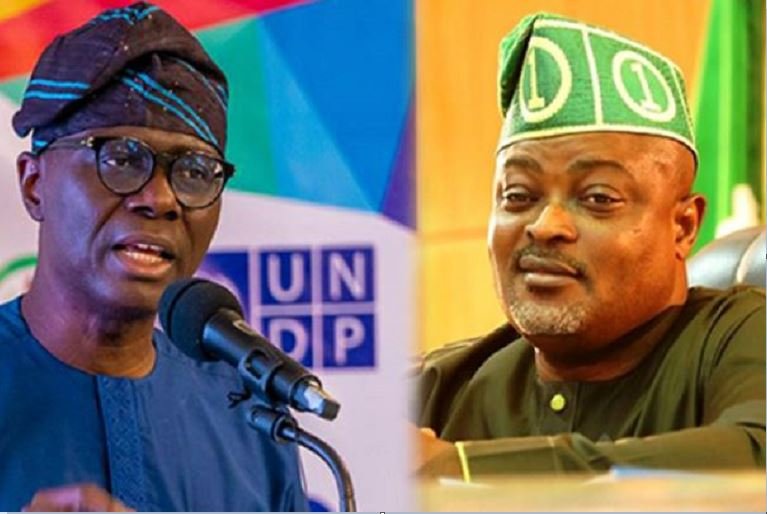
Lagos State Governor Babajide Sanwo-Olu presented a proposed N4.237 trillion budget for the fiscal year 2026 to the state House of Assembly on Tuesday, with the House promising to thoroughly review the plan.
Security was heightened within and around the Assembly complex, with police, Nigeria Security and Civil Defence Corps, and Lagos State Neighbourhood Safety Corps officers stationed at key entry points.
Members of the state executive council, local government officials, traditional rulers, and other invited guests attended the session, which was presided over by Mudashiru Obasa, the Speaker.
Sanwo-Olu began his presentation of the budget, titled “Budget of Shared Prosperity,” around 1.25 p.m.
The projected budget has a total value of N4,237,107,009,308. Its overall revenue is N3,993,774,552,141, with a deficit financing of N243,332,457,167. Internally generated revenue is N3,119,774,552,141, with federal transfers totaling N874,000,000,000.
The government proposes capital expenditure of N2,185,085,419,495 and recurring expenditure of N2,052,021,589,812.
The recurring expense, which comprises overheads, personnel costs, and debt services, has a total overhead cost of N1,084,245,843,091. Personnel and debt obligations consist of a total personnel cost of N440,494,339,384, recurrent debt charges of N143,876,701,943, and debt repayments of N383,404,705,394.
Sectoral allocations for the year include N847,472,071,966 for General Public Services, N147,040,088,897 for Public Order and Safety, N1,372,307,808,626 for Economic Affairs, N235,957,235,138 for Environment, N123,760,310,429 for Housing, N338,449,258,945 for Health, N54,682,339,586 for Recreation, N249,132,921,287 for Education, and N70,024,171,038 for Social Protection.
Speaking before the 40-member House, the governor emphasized that the 2026 proposal was designed to promote shared prosperity and build a Lagos that benefits all residents.
“Our mission remains clear: to eradicate poverty and build a Lagos that works for all,” the governor said.
“Our vision continues to guide every fiscal decision we make—to deliver a Greater Lagos where shared prosperity is not an aspiration but a lived and felt reality.”
Sanwo-Olu noted that the budget is based on four pillars: a human-centered approach, contemporary infrastructure, a thriving economy, and effective government, all of which are consistent with the state’s T.H.E.M.E.S.+ Agenda.
Mudashiru Obasa, Speaker of the House, stated that the budget prioritizes vital sectors such as healthcare, education, transportation, security, and government.
“We have all listened with rapt attention to how the wealth of our state will be utilized for our common good in 2026. The responsibility now lies with this honorable house to meticulously perform our constitutional duty,” the speaker said, vowing to scrutinize the proposed budget.
Speaking on the 2025 fiscal year, Obasa said, “I can say with confidence that the current budget’s execution has been promising, especially in health, education, transport, and security.”
“For 2026, the proposed N4.237tn budget must match Lagosians’ aspirations. It must further economic resilience, improve welfare, strengthen security, and build enduring infrastructure,” he added.