


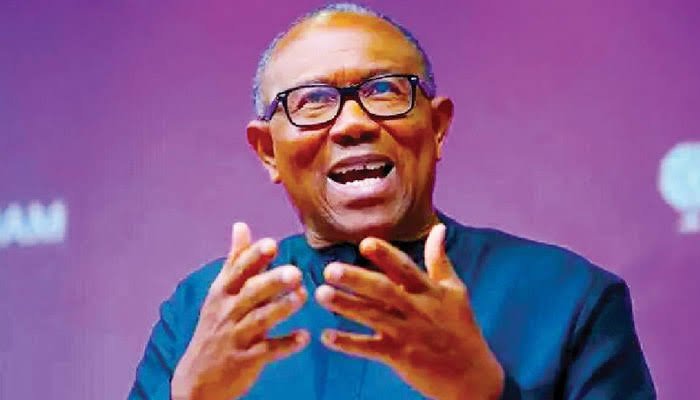
Yunusa Tanko, the National Coordinator of the Obidient Movement Worldwide, has rejected claims that the Labour Party’s defeat in the recent Anambra governorship election indicates a deterioration in the political influence of its 2023 presidential candidate, Peter Obi.
Tanko argued that “Peter Obi was not on the ballot.”
According to ARISE News on Tuesday, he emphasized that judging Obi’s political relevance based on an election in which he did not run was inaccurate.
“First of all, I watched a lot of interviews this morning, and quite a lot of people were trying to pin the election on Peter Obi. Peter Obi was not on that ballot.
“Yes, he supported George Moghalu, and he gave his support and went to three areas for campaigns, but it was the contest of George Moghalu, on which the people had to decide,” he said.
Tanko stressed that the Anambra election was about the Labour Party candidate, not Obi himself.
“All of this election hinges on the Anambrarians to decide who becomes their governor. Seventeen years ago, Peter Obi ran an election against the same Mr. Soludo and Dr. Chris Ngige.
“Put Peter Obi on the ballot today; against such individuals, he will still defeat them,” he said.
He praised Obi’s backing for the Labour Party candidate, despite internal party disagreements, as an act of political honor.
“Even though, as his choice of a candidate, he came from the Aburi leadership, and Peter Obi supported the Nenadi leadership of the Labour Party, despite that, he went ahead to give that support to show his honor for his party. That is what is honorable for any candidate,” Tanko explained.
Tanko’s interview follows comments from the Lagos State chapter of the All Progressives Congress, which advised Peter Obi to reconsider his 2027 presidential ambition, stating that the outcome of the Anambra governorship election indicated a decline in the Labour Party’s grassroots support and the influence of Obi’s Obidient Movement.
According to the party’s spokesperson, Seye Oladejo, the results in Obi’s polling unit indicate a breakdown in the LP’s base structure.
The Anambra election highlights the importance of consistent political organization and voter engagement.
Tanko attributed Obi’s continued popularity in Anambra to low voter turnout, rather than rejection.
“Do you also know the number of registered voters in Anambra is two million-plus? And then, at the end of it all, only about 500,000 decided to vote. That shows voter apathy and lack of trust in the process,” he stated.
Tanko stressed that Obi continues to command overwhelming support.
“If Peter Obi were on the ballot, this calculation wouldn’t even have arisen.
“Peter Obi is strongly supported by his people at every point. The dynamics in Anambra’s election are quite different from anywhere else,” he said.
He used Lagos as an example of Obi’s appeal, saying, “You could use Lagos as an example of how he got 100 percent of the votes, and then, at the same time, probably the voting that came to Gbadebo was different. That’s how dynamics play out in elections.”
Tanko further stated that some Labour Party defeats were caused by opportunistic politicians who capitalized on Obi’s popularity in 2023 but then deserted.
“Some of them left, and that did not give this particular trust,” he said.
Speaking on the Anambra election, he added, “It was heavily monetized, and that, of course, is vote buying, rigging, and intimidation. Within the period Mr. Peter Obi was in Anambra, he went to about seven places—all of them schools of nursing—and, focusing on his humanitarian gestures, he gave nothing less than almost ₦100 million to different schools.”
He also proposed reforms, including dividing INEC into three commissions—Enforcement, Electoral, and Delineation—to promote accountability.
“2.9 million people registered, yet only about five hundred thousand voted. That’s too low for deciding on a governor. We must build a system that rekindles trust in elections,” he concluded.