



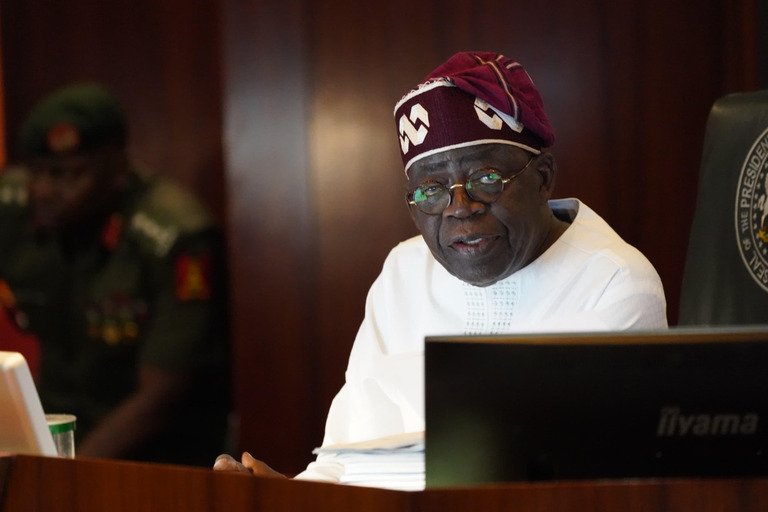
The Senior Special Assistant to the President on Community Engagement (South-East), Mrs. Chioma Wesley, says President Bola Tinubu will not make any pronouncement on the ongoing trial of the detained leader of the Indigenous People of Biafra (IPOB), Nnamdi Kanu.
Wesley spoke to State House correspondents on Monday after she and three other regional aides briefed the President at the Aso Rock Villa, Abuja.
“Nnamdi Kanu’s case is in court, and the President cannot make any pronouncement on it,” she said. “He abides by the rule of law. So, for now, we wait for the court to make that decision.”
Her comments followed renewed calls, especially from parts of the South-East, for Kanu’s release.
Kanu, leader of the proscribed IPOB, was first arrested in 2015. He was granted bail in 2017 but left the country after a military operation in his hometown, Afaraukwu, Abia State.
He was rearrested and returned to Nigeria in June 2021, and has since remained in the custody of the Department of State Services (DSS).
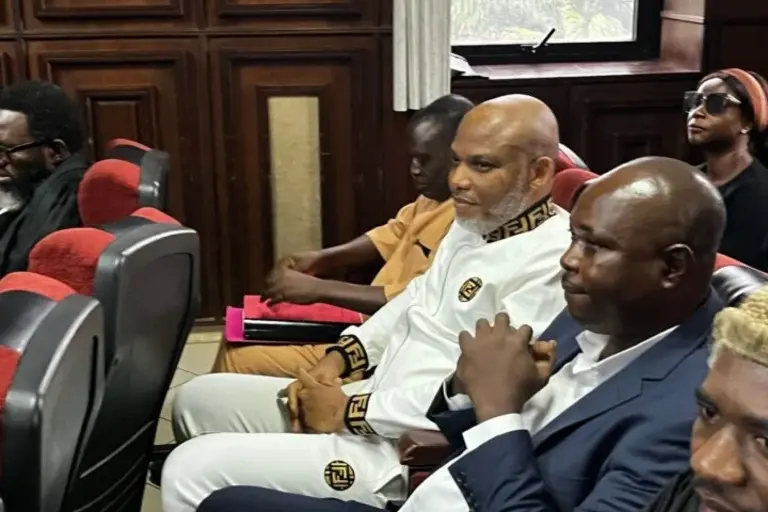
The Federal High Court has fixed November 20, 2025, to deliver judgment in his terrorism case after Kanu declined for the sixth time to open a defence.
Wesley said her South-East office has created a citizens’ assembly to connect the Presidency with communities.
“We hit the ground running by setting up a citizens’ assembly where we can hear everything citizens in the South-East have to say about the President,” she said. “We are taking the President’s policies to the grassroots and ensuring that the people know what the President is doing for them.”
“Our work is in the field. We are taking the Presidency down to the grassroots,” she added, noting that the team’s “greatest weapon is feedback.”
From the North-Central, Dr. Abiodun Essiet told reporters that the region had activated a structured, community-led response to long-running flashpoints and mistrust.
“For the North-Central region, we’ve launched what we call the Presidential Community Engagement Peace Structures across 121 local governments,” she said. “We’ve set up community peace structures to strengthen peace and social cohesion across the region.”
“This week, I’ll be going to Plateau State to set up another community peace structure,” she added. “We’ll be engaging leaders of associations—from CAN to MACBAN to Miyetti Allah—traditional rulers, youth groups, and the NCWS—to be on the same page about peace and how to strengthen social cohesion in the North-Central.”
Essiet linked local insecurity to long-standing grievances and poor infrastructure.
“I shared with the President the level of insecurity in our region, from historical mistrust to different levels of land grabbing,” she said, adding that “illegal mining is also increasing insecurity.”
She warned that bad roads between Kogi and Kwara States are worsening insecurity, with bandits occupying ungoverned forests. She noted that the President “has promised to strengthen the peace structures.”
Essiet emphasised that the team is building a standing, community-level network to report and de-escalate conflicts.
In the North-West, the Senior Special Assistant to the President on Community Engagement, Abdullahi Yakasai, said his office is simultaneously addressing out-of-school children, farm-input bottlenecks, and voter registration.
“We highlighted to Mr. President the level of out-of-school children, and through my office, we’ve been able to enrol 4,000 children into primary schools within these two years,” he said. “We provide them with educational materials, exercise books, uniforms, and everything they need to stay in school.”
He explained that his team operates independently, not in collaboration with state governments.
“We also discussed the need for voter registration,” he said. “We are sensitising our youth—those without voter cards—to go and register.”
Yakasai stressed that the initiative is non-partisan.
“We are doing this INEC registration not because of party affiliation. It’s every Nigerian’s civic responsibility to register and vote—be it APC, APGA, PDP, or any other party,” he said.
From the South-West, Mrs. Moreno Ojudu said her office is prioritising national identification, social protection, and peacebuilding.
“The registration of NIN is very important, and we must nurture our people from cradle to grave,” she said. “The Presidential Community Engagement Team exists to engage, enlighten, empower, and help people understand the key outlines of the Renewed Hope Agenda.”
She added that the aides would continue to “appeal to major stakeholders in the community” and ensure every effort is made “to safeguard our country.”
Responding to questions on visibility and funding, the aides said their operations are largely field-based and partnership-driven.
“We work with international development partners, NGOs, and multinational companies engaged in corporate social responsibility,” Yakasai explained.
Essiet added that the teams liaise constantly with ministries, departments, and agencies to “pull whatever we can for our people at the community level.”