
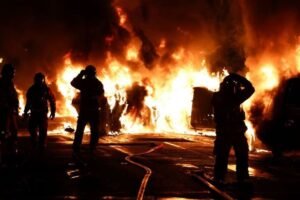



Growing political violence ahead of Nigeria’s 2027 general elections is raising concerns about the country’s democratic stability, investor confidence and economic outlook.
The Centre for the Promotion of Private Enterprise (CPPE) has warned that escalating political intimidation, attacks on opposition activities and disregard for the rule of law could trigger capital flight, disrupt businesses and discourage foreign investment.
The concerns come as political parties, civil society organisations and prominent Nigerians call for urgent measures to prevent further attacks and protect democratic participation.
The Socio-Economic Rights and Accountability Project (SERAP) has also given the Independent National Electoral Commission (INEC) seven days to prosecute electoral violence suspects or face legal action.
SERAP gives INEC seven days to prosecute suspects
In a letter signed by its Deputy Director, Kolawole Oluwadare, SERAP urged INEC Chairman, Joash Amupitan, to obtain police investigation reports and case files concerning suspects arrested over electoral and political violence since campaigns began on August 19, 2026.
The organisation asked the commission to review the evidence and prosecute suspects where sufficient grounds exist under the Electoral Act 2026.
It warned that failure to act within seven days of receiving or publishing the letter would prompt legal action.
SERAP also urged INEC to press the police to conclude investigations into reported attacks, identify suspected perpetrators and their sponsors, and ensure they face prosecution.
The organisation cited several provisions of the Electoral Act, including Section 96, which prohibits political parties, aspirants and candidates from organising or equipping groups to use force or coercion for political purposes.
It also referenced Sections 97 and 120, which prohibit threats of violence during campaigns and criminalise disorderly conduct intended to disrupt political meetings.
Among the incidents highlighted were the reported obstruction of the convoy of Nigeria Democratic Congress (NDC) presidential candidate Peter Obi in Benue State on September 8.
Other cases included attacks on political meetings in Enugu State, an attack on the convoy of ADC senatorial candidate Herberta Okonofua in Edo State, and violence involving supporters of governorship candidates in Enugu and Oyo states.
SERAP also listed an attack on NDC candidate Rollins Offia-Nwali’s convoy in Ebonyi State on October 22, which reportedly left one person dead and three injured.
The organisation further cited the reported attack on African Action Congress (AAC) presidential candidate Omoyele Sowore and his team in Ado-Ekiti on October 30, as well as an attack on Obi’s convoy in Calabar on November 4.
CPPE warns political violence could trigger capital flight
Chief Executive Officer of CPPE, Muda Yusuf, warned that sustained political violence could undermine Nigeria’s investment climate and worsen existing economic challenges.
In a policy brief titled Political Violence and Institutional Neutrality: Safeguarding Investor Confidence Ahead of the 2027 Elections, Yusuf identified capital flight, foreign exchange volatility, business disruptions and rising operating costs as potential consequences.
He explained that political clashes, insecurity and violent protests could disrupt supply chains, logistics, commercial activities and market access.
Businesses could also face higher expenditure on security, insurance, transportation and contingency arrangements.
According to him, prolonged instability could damage Nigeria’s reputation as an investment destination, particularly affecting small businesses, informal enterprises and investors with fixed assets that cannot easily be relocated.
Yusuf also expressed concern about the politicisation of state institutions, particularly INEC, security agencies and the judiciary.
He called for an independent, transparent and professional electoral commission, alongside impartial security operations and an independent judiciary capable of resolving electoral disputes fairly.
Dickson calls for emergency all-party summit
Meanwhile, NDC National Leader Henry Seriake Dickson has called for an urgent all-party summit to address growing political thuggery and violence ahead of the 2027 elections.
In a statement, Dickson urged the Inter-Party Advisory Council (IPAC) and the National Peace Committee, led by former Head of State Abdulsalami Abubakar, to work with INEC and security agencies to convene the meeting.
He said the summit would provide political parties with an opportunity to recommit to peaceful, fair and transparent elections.
Dickson expressed concern over increasing attacks on the NDC, its candidates and supporters, warning that unchecked violence could undermine the electoral process before voting begins.
Former Minister of Youth and Sports, Solomon Dalung, also urged state governors to allow opposition parties to organise and mobilise without intimidation.
He commended Bauchi State Governor Bala Mohammed for reportedly allowing the ADC to mobilise freely in the state.
“Political tolerance is not a favour a governor grants to the opposition; it is a constitutional obligation,” Dalung said.
Wabara raises concerns over opposition parties
Former Senate President and Chairman of the Peoples Democratic Party (PDP) Board of Trustees, Adolphus Wabara, has also criticised the handling of opposition party disputes ahead of the 2027 elections.
Wabara accused the ruling All Progressives Congress (APC) of benefiting from prolonged crises within opposition parties, warning that weakening political alternatives could undermine Nigeria’s democracy.
He made the remarks while reacting to the Court of Appeal’s decision in the PDP leadership dispute.
The appellate court reportedly upheld the July 17, 2026, Federal High Court judgment dismissing the suit filed by the Wabara-led faction.
Wabara faulted the decision and questioned the circumstances surrounding the emergence of the Abdulrahman Muhammad-led faction.
He warned that the legal battles involving the PDP, ADC and NDC could weaken opposition participation in the 2027 elections.
“The opposition should be allowed to breathe. Nigeria cannot afford a situation where formidable opposition parties are weakened to the point that nobody can effectively challenge the ruling party in 2027,” he said.
“Tinubu should not be made a sole presidential candidate in 2027. That would be anti-democratic and a dangerous precedent capable of bringing avoidable embarrassment to our country.”
The growing concerns over political violence and opposition participation have renewed calls for stronger enforcement of electoral laws, institutional independence and peaceful political engagement ahead of the 2027 general elections.