


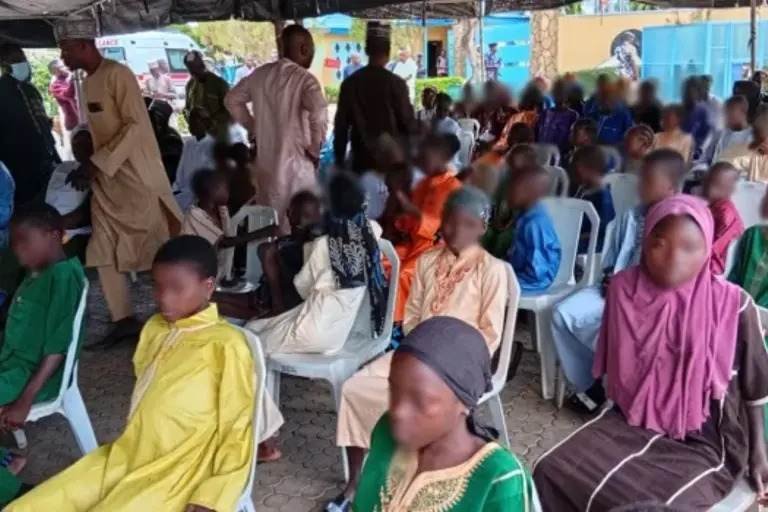
At least 13 captives died during the nearly six months in captivity, while 12 children were still being held by the terrorists after they were kidnapped during the February 3 terrorist attack on Woro and Nuku communities in Kaiama Local Government Area of Kwara State.
This was revealed on Friday by some of the rescued victims, after being formally received by the Kwara State Government, that they ate one meal each day and slept in the open forest.
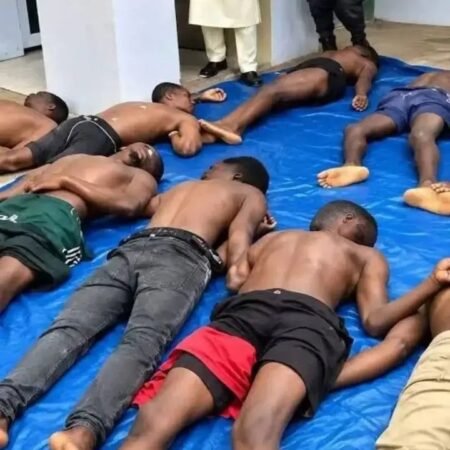
The victims were among the 176 women and children kidnapped when insurgents suspected to be Boko Haram terrorists staged coordinated raids on Woro and neighbouring Nuku villages.
Hundreds of gunmen on motorbikes reportedly stormed the neighbourhoods after residents rejected the group’s radical ideology.
The assailants razed homes, shops, and the traditional ruler’s palace, killing scores of civilians.
The abductees were finally released on Wednesday.
Recounting her ordeal, one of the survivors, Nafisat Abdulfatai, stated that some youngsters remained in the forest because the abductors threatened them with slavery if they tried to flee.
She said, “Thirteen people died among us during our time in captivity. Twelve children are still with the terrorists. The abductors threatened to enslave anyone who tried to leave, so they weren’t released with us.
“Out of fear, the children agreed to remain behind. Two of them were specifically forced to stay because the terrorists believed they were old enough. In truth, those children were compelled to remain. We pray that God will also bring them back safely.”
Abdulfatai further stated that although the captives were not routinely beaten or physically assaulted, they endured severe hunger and deprivation throughout their stay in the forest.
“We were not allowed to eat what we wanted. Most days, we ate only once. Our meals were prepared with only salt—there was no oil or other ingredients. We survived mainly on ‘luru’ soup. Many of us ended up eating things we never imagined we would eat in our lifetime.”
“There were days when we had nothing to eat from morning until night. Sometimes, our only meal came around 7 p.m. or 8 p.m. The suffering was unimaginable,” she recounted.
Abdulfatai, however, mentioned a brief period when the abductors slaughtered cattle for the captives.
“About a month after we arrived in the forest, they slaughtered two cows every day for five consecutive days, making a total of 10 cows.
“They also slaughtered two more cows before our release. They gave each of us two yards of cloth on two different occasions, but that did not lessen our suffering.”
Speaking on the living conditions, Abdulfatai stated that the captives spent months sleeping in the open forest before being moved into a makeshift shelter after several children died.
She said, “We slept inside the thick bush. The first rainfall arrived while we remained completely exposed, and it continued until we were still there. It was only after some children died that they erected a makeshift shelter with trampoline material.
“We were too many. Initially, 176 of us were abducted from Woro, and later about 76 other captives from another settlement were brought to join us.
“We slept under that temporary structure like animals. Whenever it rained, some people had to sleep on top of others because there was no space. When there was no rain, we preferred to sleep under the trees besides the river. That was where we slept, woke up every morning and spent our days.”
The survivor also disclosed that several pregnant women gave birth while in captivity, but not all of the babies survived.
She said, “There were pregnant women and nursing mothers among us. Some women gave birth in captivity but lost their babies. About six or seven women experienced that tragedy, while others returned with their babies.
“Some of the rescued victims are currently receiving treatment because they are seriously ill. We are all affected, but some are in much worse condition.”
Expressing gratitude for her rescue, Abdulfatai noted that she had almost given up hope of ever seeing her family again.
She said, “Alhamdulillah. I never believed I would see my parents, my husband and my children again. Many of the children have become orphans because of what happened.
“I thank God that I came out alive and that my husband survived. I especially appreciate our families because I know they suffered even more emotionally while we were in captivity.
“I thank God, and I sincerely appreciate Governor AbdulRahman AbdulRazaq for everything he has done for us. May Almighty Allah reward him abundantly.”
Another rescued victim, Nafisat Yusuf, described the anguish they faced during their months in the militants’ camp.
She stated, “We suffered beyond words. The terrorists subjected us to terrible hardship. Many children died while we were there. The suffering was indescribable.
“We thank Almighty God for bringing us out alive, and we are grateful to the governor for making our rescue possible. Every day, we prayed that God would save us from that place, and today He has answered our prayers.”
Speaking on the rescue operation, Yusuf said the victims were evacuated by security personnel whose identities they did not know.
She said, “It was soldiers who came to bring us out of the forest, but we do not know the names of those who rescued us. We are simply grateful that they came.”
Narrating the abduction, she said the attack happened so suddenly that she had little knowledge of what transpired in the village after they were taken away.
“They came for us on February 3. All I know is that they stormed the community and abducted us. Whatever happened in the village after we were taken, I did not witness it.”
She also stated that while the captors occasionally provided food, life in captivity remained unbearable.
“They gave us food at times and provided a few basic things, but the level of suffering we experienced cannot be described. Some of us cried every day, while many others remained sick throughout our stay. We simply thank God that we have finally regained our freedom.”