




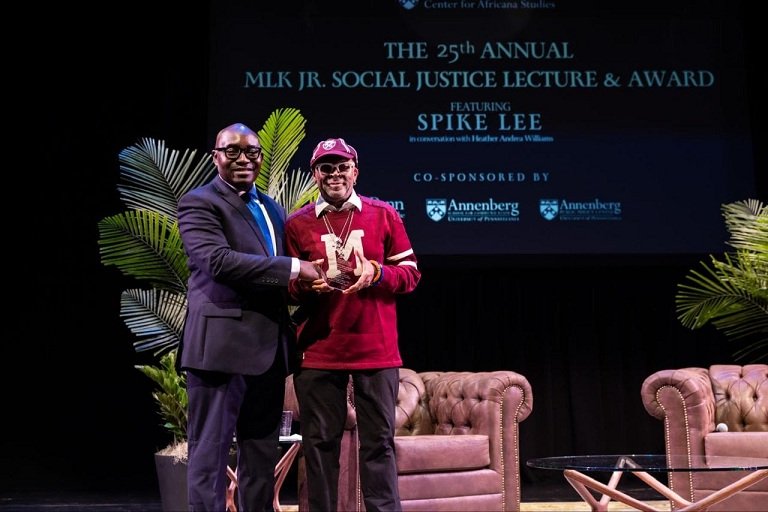
At a historic and well-attended event at the Ivy League University of Pennsylvania, the Director of the Center for Africana Studies, Nigerian-born Professor Wale Adebanwi, presented the Centre’s 25th edition of the Rev. Martin Luther King Jr. Social Justice Award to iconic filmmaker Spike Lee.
The event, which took place in January 20, at UPenn’s Annenberg Center inside the Zellerbach Theatre, was attended by over 900 guests. The audience listened attentively as Spike Lee delivered the Social Justice Lecture associated with the award through a conversation with Heather Andrea Williams, Adebanwi’s colleague at UPenn. Williams has known Lee’s family for many years.
Adebanwi said the honour bestowed on Spike Lee was in recognition of his long-standing commitment to social justice.
He said: “Mr. Lee has exemplified the spirit of social justice throughout his remarkable body of work, never failing to be provocative, courageous, and unafraid to speak truth to power. His art has been a powerful instrument in the historic freedom struggle, challenging audiences to confront injustice not as abstraction, but as lived reality.
“Tonight, we honour not only a filmmaker, but a moral witness—an artist whose work has helped shape public consciousness and whose voice continues to insist that America confront its past, reckon with its present, and imagine a more just future.”
While reviewing Lee’s impact, Adebanwi observed that for over four decades, Spike Lee has used film as a form of social critique, forcing audiences to confront racism, inequality, police violence, historical amnesia, and the consequences of silence in the face of injustice.
“Indeed, he is a giant in the landscape of American culture and a transformative figure in US history. Given that cinema has existed for barely 130 years, Spike Lee has emerged as one of the most daring filmmakers in the medium’s history.
“Throughout his life and career, he has not offered easy answers nor sought approval. Instead, he insists on being unapologetically honest.
“Like Dr. King, Spike Lee understands that justice is not passive, and that art, when rooted in truth, can be a vehicle for change. We see this clearly in his body of work.”
According to a statement on the University of Pennsylvania website, the annual MLK Jr. Social Justice Lecture and Award celebrates the life and legacy of Dr. Martin Luther King Jr. and features a speaker of African descent distinguished for social justice advocacy.
The event was co-sponsored by the Penn Office of the President, the Annenberg School for Communication, and the Annenberg Public Policy Center.
Adebanwi, who is also the Presidential Penn Compact Professor of Africana Studies at UPenn, said:
“The Center for Africana Studies hosts the MLK Jr. Lecture and Award annually. Spike Lee was our honouree this year. He was a great guest, and the capacity audience in our 900-plus-seat hall had an excellent time as he engaged in dialogue with my colleague, who has known him and his mother for many years.”
Lee received a standing ovation at the end of the conversation and expressed his interest in collaborating with the Center in the future, including hosting a screening of his documentary on the bombing of churches in the southern United States during the 1960s.