




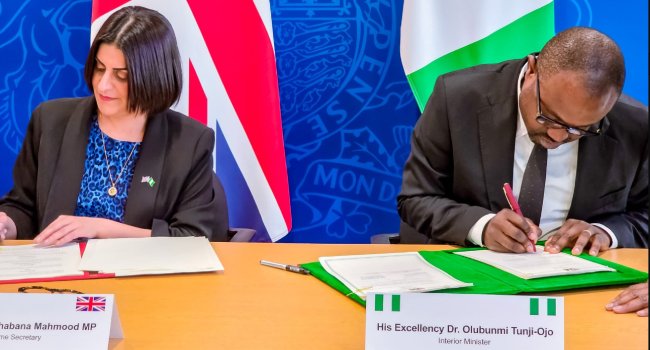
The United Kingdom (UK) and Nigeria have signed a three-year strategic plan aimed at tackling organised immigration crime and strengthening border security cooperation.
The agreement was announced in a joint statement by the UK Home Office during President Bola Tinubu’s state visit to the UK.
Both countries said the initiative reflects a shared priority to curb migration-related crimes and improve border control systems.
“We… announce our intention to expand cooperation to reduce organised immigration crime and the risks associated with it,” the statement read.
What the UK–Nigeria immigration pact covers
The deal was signed by Shabana Mahmood and Olubunmi Tunji-Ojo, outlining measures to tighten visa processes and strengthen enforcement.
Under the plan, Nigeria will review its legal framework to introduce stricter penalties for immigration offences, especially those involving forged travel documents.
Both countries also agreed to expand legal powers to prosecute offenders, strengthen visa and travel documentation systems, improve intelligence sharing and joint operations and boost for border security and migrant protection.
The partnership will reinforce the UK–Nigeria Organised Immigration Crime Unit through new agreements on data sharing and operational collaboration.
The UK also pledged support through training and capacity building for Nigerian border agencies, while both countries committed to protecting vulnerable migrants, particularly women and children.
The plan includes improved document verification systems, enhanced research, and regular reviews under the UK–Nigeria Migration, Justice and Home Affairs Dialogue.
Tinubu’s UK visit yields major agreements
The immigration pact is part of wider engagements during Tinubu’s visit to the UK, hosted by King Charles III.
The visit featured high-level talks, ceremonial events, and a state banquet, marking a renewed push to deepen bilateral ties.
It also produced a £746 million financing agreement to modernise Nigeria’s key seaports in Apapa and Tin Can Island.
Both governments described the new immigration deal as a reflection of “partnership, mutual support and shared understanding” in addressing shared security challenges.