


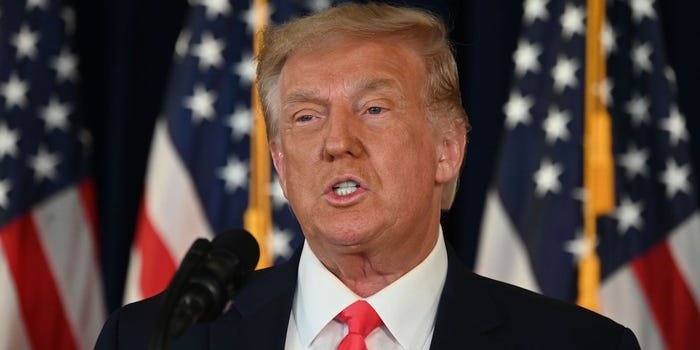
US President Donald Trump has promised to completely destroy the Iranian missile industry and also obliterate their navy.
The US and Israel launched a wave of strikes against targets in Iranian cities on Saturday, triggering explosions and columns of smoke in the capital Tehran.
Following Trump’s criticism of Iran’s position in talks on its nuclear and missile programs, the assaults took place.
Israeli Defense Minister Israel Katz referred to the action as a “preventive strike,” while Trump stated that Washington’s objective was “eliminating imminent threats” from Iran.
“The United States’ military began major combat operations in Iran,” Trump said in a video message posted on his social media site while he spent the weekend at his Florida golf club.
“We are going to destroy their missiles and raze their missile industry to the ground. It will be totally, again, obliterated. We’re going to annihilate their navy,” Trump said.
He declared that the “hour of your freedom is at hand” and offered the Iranian soldiers “immunity” or “certain death.”
The Fars news agency stated that “seven missile impacts were reported in the Keshvardoost and Pasteur districts” of Tehran, while Iranian state television declared that President Pezeshkian was “safe and sound.”
“I saw with my own eyes two Tomahawk missiles flying horizontally toward targets,” an office worker told AFP on condition of anonymity. “At first we heard a dull noise and thought it was a fighter jet.”
AFP reporters in Tehran witnessed two massive smoke columns rising over the city center and heard explosions. Although there was no immediate confirmation of casualties, the health ministry stated that ambulances had been sent out.
The US embassies in Qatar and Bahrain advised US people to seek shelter, and Israel, Iran, and Iraq all closed their airspace to civilian traffic after the strikes started.
Israeli officials sent out a mobile warning to the public after sirens sounded in Jerusalem.
With the USS Gerald R. Ford, the largest aircraft carrier in the world, en route to the Israeli coast, Trump had ordered the largest military buildup in decades in the Middle East.
Trump claimed Friday that the state was “not willing to give us what we have to have,” one day after the United States and Iran resumed negotiations in Geneva.
However, Oman, the mediator of the Geneva negotiations, presented a considerably more optimistic view, claiming that Iran had committed to having no uranium in stockpiles and that the subject of enrichment level was meaningless.
According to Badr Albusaidi, the foreign minister of Oman, who was meeting US Vice President JD Vance in Washington, Iran also consented to turn existing stocks into gasoline.
The strikes occur weeks after thousands of people were slain by Iranian authorities during the suppression of large-scale demonstrations.
In a 2015 agreement that Trump tore up during his first time in office, Iran agreed to limitations on low-level enrichment.
According to the State Department, US Secretary of State Marco Rubio will visit Israel on Monday to discuss Iran.
The senior US ambassador will fly without media on his plane, an unusual departure from decades of practice.
In his State of the Union speech on Tuesday, Trump claimed that Iran was creating missiles capable of hitting the US.
Later, Rubio stated that if Iran did not talk about its missiles, it would have a “very big problem.” Iran has demanded that the nuclear issue be the main topic of the current negotiations.
Rubio increased pressure by designating Iran on Friday as a state sponsor of unjust detentions—a new blacklist—for the incarceration of US citizens.
“Success in this path requires seriousness and realism from the other side and avoidance of any miscalculation and excessive demands,” Iranian Foreign Minister Abbas Araghchi stated on Friday.
The UN nuclear watchdog, the International Atomic Energy Agency, revealed it would hold technical discussions with Iran on Monday.