


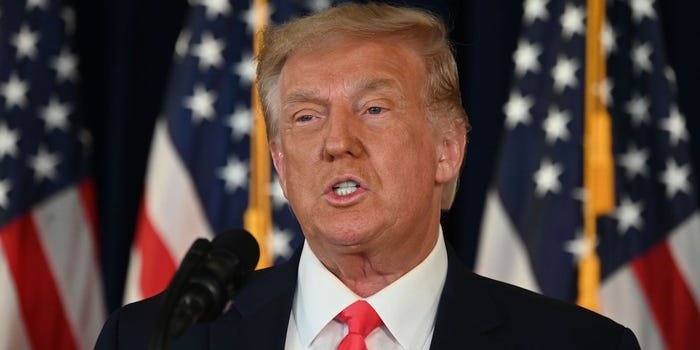
Friedrich Merz of Germany was welcomed by US President Donald Trump on Tuesday for his first meeting with a foreign leader since he joined Israel in the attacks on Iran that have sparked a conflict in the Middle East.
As part of a larger effort to mend strained transatlantic ties, the long-planned White House discussion was expected to center on the conflict in Ukraine and tense EU-US economic relations.
However, Tehran has retaliated against US bases and partners in the region as a result of Trump’s indication that airstrikes against Iran could continue for weeks, upending the international agenda.
Berlin shared the “relief” of the Iranian people that the “mullah regime is coming to an end,” according to Merz, a severe critic of the leadership of the Islamic Republic.
However, he refused to “lecture” Israel and the United States about the legitimacy of the Iranian strikes meant to halt Tehran’s nuclear and missile programs.
Additionally, Germany, France, and Britain have declared that they will only support their Gulf allies with “defensive action” against Iran.
US officials denounced that as a “soft” response to “Operation Epic Fury,” which might place Merz at the center of Trump’s wrath.
Germany is a “key partner in this effort,” according to French President Emmanuel Macron, who subsequently stated that eight European nations had agreed to join his plan to utilize France’s nuclear stockpile to strengthen security on the continent.
Trump, 79, a real estate billionaire and former reality TV star, and Merz, 70, a Christian Democrat with multilateral impulses, are very different.
However, Merz has been able to have friendly relations with Trump and avoid his anger or mockery.
He has achieved this in part by satisfying a crucial Trump demand that European NATO countries increase their defense spending, including significant increases in German investments.
However, Merz has occasionally retaliated against the erratic US president, particularly regarding Ukraine, and frequently maintains that Europe needs to achieve greater autonomy during periods of geopolitical turmoil.
Merz called on America to “repair and revive transatlantic trust together” after pointing out the “deep rift” between the traditional allies at the Munich Security Conference in February.
Merz had also urged Trump to put more pressure on Moscow to put a stop to the “horrible” war in Ukraine at their first White House meeting in June.
At the time, Trump described Merz as “a very good man to deal with” and jokingly stated that he might be “difficult,” remarks that were generally interpreted as positive rather than disparaging.
Merz also highlighted Trump’s German ancestry by giving him his grandfather’s German birth certificate and extending an invitation for him to travel to his own country.
A spokesman stated that Merz will present the EU’s “coordinated position” regarding Trump’s tariff blitz, adding that “businesses need planning security, and that applies on both sides of the Atlantic.”
He was encouraged by Germany’s mechanical engineering lobby organization to “use his good relationship with US President Trump to achieve a comprehensive and reliable tariff agreement between the EU and the USA,” “despite the current focus on the Iran war.”