

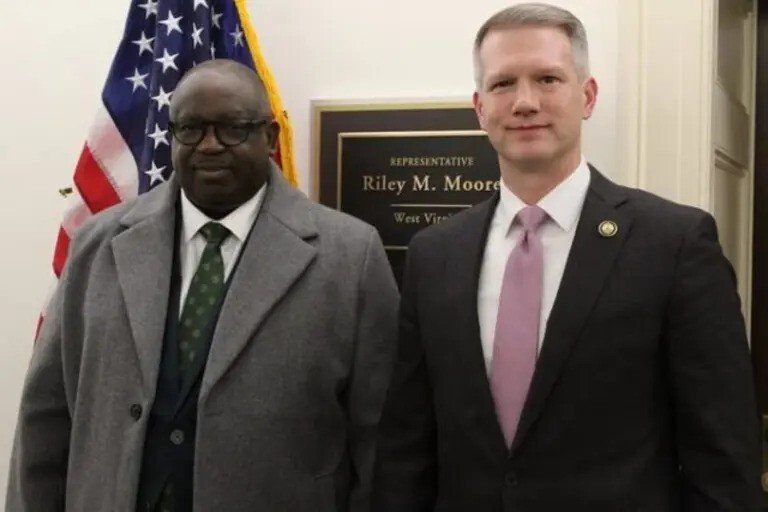
Riley Moore, a member of the United States House of Representatives, has reiterated his commitment to collaborating with the Nigerian government to alleviate insecurity and persecution of Christians, particularly in the country’s Middle Belt.
The statement came following his meeting with Plateau State Governor Caleb Mutfwang, during which the two leaders discussed ways to strengthen bilateral relations.
Moore reacted to the engagement in a statement posted on his official platform, saying, “It was an honor to meet with the Governor of Plateau State in Nigeria, Caleb Mutfwang, yesterday,” emphasizing the importance of direct dialogue with key state leaders.
He described the meeting as meaningful and forward-looking, emphasizing the importance of improving bilateral collaboration.
“We had a meaningful and productive conversation about deepening the ties between our two countries,” Moore added, emphasizing the shared interest in strengthening diplomatic, security, and economic links.
Moore also emphasized the United States’ commitment to supporting Nigeria in addressing pressing security challenges.
“I remain committed to working with the Nigerian government in coordination and cooperation to address these security and economic challenges, especially the persecution our Christian brothers and sisters face,” he said, underlining the particular concern for vulnerable communities in the Middle Belt.
Concluding his remarks, Moore applauded the efforts of Mutfwang in safeguarding citizens.
“God bless you, Governor, for what you do to protect Christians and other vulnerable populations in the Middle Belt,” he stated, acknowledging the local leadership’s role in promoting security and religious freedom.
The affirmation came following the formation of the US-Nigeria Joint Working Group, which the Federal Government described as a “lifetime opportunity” to combat violent terrorism and end Christian persecution in Nigeria.
The Federal Government delegation, led by National Security Adviser Nuhu Ribadu, met with US representatives in Abuja for the Working Group’s initial session.
The engagement centered on addressing insecurity, supporting religious freedom, and enhancing bilateral cooperation.
Bayo Onanuga, the president’s special adviser on information and strategy, stated that the working group was formed to strengthen bilateral cooperation.
Its goals include decreasing violence against vulnerable communities, notably Christians, improving accountability for attacks, and protecting civilians.
The engagement follows Nigeria’s designation as a Country of Particular Concern by US President Donald Trump, emphasizing the importance of bilateral cooperation in addressing security difficulties and human rights concerns.