

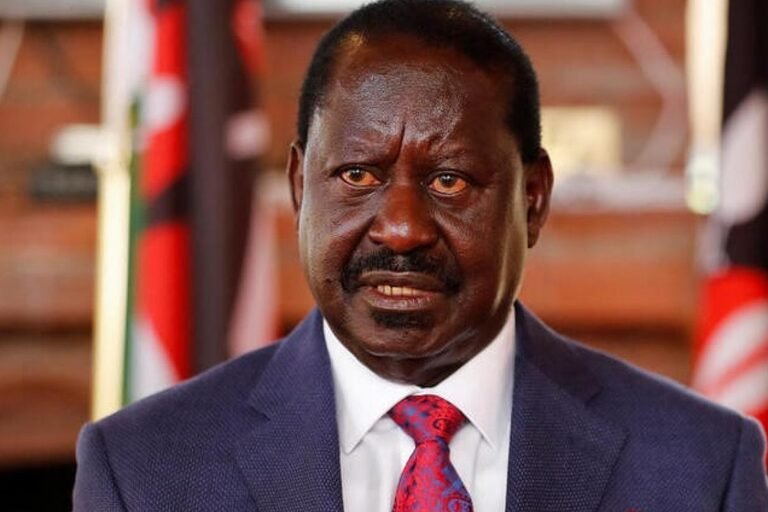
Four people were killed in Nairobi, Kenya’s capital, after security forces fired shots and deployed tear gas to disperse large crowds assembled at a stadium where opposition leader Raila Odinga’s body lying in state.
According to Reuters, Odinga, a towering figure in Kenyan politics who once served as a political prisoner and ran unsuccessfully for president five times, died on Wednesday at the age of 80 in India, where he was undergoing medical care.
Following his death, President Ruto proclaimed seven days of national mourning, with a state funeral planned in his native region.
Thousands of his fans marched to the streets early in the morning.
A large crowd pushed through the stadium’s main gate, causing guards to fire rounds into the air.
According to a police source, two persons were fatally shot at the stadium.
Local stations KTN News and Citizen TV later reported that the death toll had increased to four, with scores injured. After the rounds were fired, police used tear gas to disperse the mourning, leaving the stadium empty.
Earlier in the day, thousands of mourners stormed Nairobi’s international airport, disrupting a ceremony where President William Ruto and other dignitaries would receive Odinga’s remains with military honors.
That resulted in a two-hour halt of airport operations. Crowds also rushed neighboring roadways and attempted to enter Parliament, where a public viewing was initially scheduled.
Odinga was generally recognized as an opposition leader, although he also served as prime minister in 2008. Last year, he formed a political partnership with President Ruto, continuing a career of shifting alliances.
His most ardent followers are members of his Luo ethnic group in western Kenya, many of whom believe he was denied the presidency due to electoral fraud.
The vibe at the stadium was dismal. Felix Ambani Uneck, a university student, told Reuters, “He fought tirelessly for multi-party democracy, and we are enjoying those freedoms today because of his struggle.”
Raila Odinga had been a prominent political player in Kenya for decades, first rising to prominence in the 1990s as a pro-democracy activist.
He briefly served as deputy prime minister before becoming prime minister of a unity government created in response to the disputed 2007 election violence.
According to AP News, one of his lasting achievements was his advocacy for the Kenyan Constitution of 2010, which included significant political reforms.
His political style was frequently combative, and he survived numerous spells of arrest and allegations from competing camps, according to The Guardian.