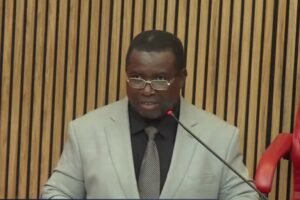



Each time I listen to presentations on the economy by Peter Obi, the former governor of Anambra State, and vice presidential candidate of the Peoples Democratic Party (PDP), my mind immediately gets compelled to query whether he fully comprehends the concepts of pure capitalism (laissez-faire capitalism), mixed economy, socialism, et al, and how they are being practised in various countries across the globe today.
And I’ve been thinking, if Obi was well acquainted with the workings of the aforementioned economic systems, including their merits and demerits, would he have referred to the problem of inequality currently raging in the United States as a “small problem”, and then proceed to vaguely portray the Chinese economy as the best model for Nigeria to immediately imbibe hook, line and sinker, in its quest for economic prosperity?
Obi made the above inferences when Kadaria Ahmed, the host of The Candidates, a political forum hosted by the NTA, asked him if he had a proper understanding of one of the growing demerits of capitalism such as inequality, as evident in the United States, where a certain percentage of the population is currently feeling left-out in the scheme of things.
The former Anambra governor keeps making references to China as a successful economic model whenever he talks about the Nigerian economy. It’s his wish that we become Africa’s China. And please get me correctly; I have no problem with that. My paramount concern lies in our country’s economic development and growth. But while we seek to be catapulted to an economic eldorado, we must not muddle up basic concepts and get ourselves confused the more.
Is Obi aware of the fact that even though China opened up trade about a decade ago, the country still largely maintains a socialist economy with a closed but more modern banking system. Yes indeed, China has removed quite a number of restrictions in terms of private participation in economic activities, which in turn has led to visible economic prosperity, but the general perception is that the state is still in ascendancy at the expense of the private sector, in so many other fronts.
Due to China’s political history and the economic system of governance that it has adopted, its public sector accounts for a bigger share of the national economy than the flourishing private sector. While Beijing has hinted that it would support small and medium-sized private companies, the government has carefully placed the state-owned enterprises (SOEs) at exclusive vantage positions to amasse greater resources and influence.
China’s top SOEs are beneficiaries of certain government policies tailored to ensure that they maintain an upper hand in the economy, making them “national champions”. SOEs get exceptional approvals for land, hydrocarbons, finance, telecoms, electricity, steel, minerals etc. They enjoy preferential access to bank facilities and the ability to issue publicly traded equity and debt. SOEs are not under the same tax burdens as their private sector competitors.
Essentially, the basic difference between the capitalist economic system (capitalism), and the socialist economic system (socialism), is that in the former, the state does not own and control all the factors of production (land, labour, capital, enterprise), while in the latter, the state owns and controls most, or all the factors of production.
For example, unlike in the United States or Nigeria, where banks are privately owned and governed by private economic interests – with some regulation by the government, banking (lending and credit) in China is completely under state control. Depending on the situation, the state directs the banks to either hold back on credit or to increase their lending.
Aside the fact that you cannot own a private bank in China, you cannot also get into other very important sectors on the ‘negative list’ because they are the sectors reserved for state-owned companies.
According to Han Zhu, Director of Shangdao Institute for Social Research and a Research Fellow at Fudan University in China, “It is the socialist theory and path that have propelled China to its current status as the world’s second-largest economy. In the future, 10 or 15 years, the socialist path with Chinese characteristics is likely to make China become the largest economy. Socialism is the choice of the Chinese people and the choice of history. In the last century, the basic problem China faced was survival and state building.”
READ: Ngozi Okonjo-Iweala in running for World Bank President
In sum, China practises an economic system that is basically hinged on public ownership of most, if not all the factors of production and joint development of diverse forms of ownership, maintaining the socialist principles of fairness and justice.
So, Obi must cearly, in unambiguous terms, tell us what type of economic system that he is actually proposing for our country:
Should we follow the teachings of Marxist-Lennist socialist scholars, ‘fundamentalists’ if you like, and transform Nigeria to utopia, while massaging the ego of communism, and maintaining the blossoming romance with capitalism?
Or should we strictu sensu, emulate the principles of pure capitalism, completely open up our economy to the dictates of market forces, and damn the consequences therefrom?
Does the PDP’s vice presidential candidate want Nigeria to operate a mixed economy like the United States (a little to the right, and a little to the left), whilst contending with the rising problems of capitalism, especially mass inequality?
Or maybe we should just develop our own distinct economic system, with strict attention placed on our peculiarities and economic realities?
Mr Obi, please be more specific Sir!
– Solomon Okocha is a researcher in the field of Urban and Regional Planning