



Nigeria has unveiled an ambitious new poverty reduction framework aimed at lifting 50 million citizens out of hardship within five years.
The Federal Government, under President Bola Tinubu, has launched the ‘One Humanitarian, One Poverty Response System (OHOPRS)’ in Abuja — a unified national strategy designed to tackle multidimensional poverty through coordinated action and data-driven governance.
At the heart of the plan is a N16 trillion funding target between 2026 and 2030. According to the financial blueprint, the government will contribute N1.5 trillion annually, alongside N800 billion from development partners, N600 billion from private sector and impact investors, and N300 billion from climate and global funds.
Key contributors include global institutions such as the World Bank, European Union, and United Nations, alongside bilateral donors and philanthropic foundations.
New funding model and oversight
The initiative will be anchored by a National Humanitarian and Poverty Reduction Trust Fund, leveraging blended financing models including climate finance, social impact bonds, Islamic finance instruments like Zakat and Sukuk, and carbon credit mechanisms.
To ensure transparency, the system introduces multiple layers of oversight, including a national steering committee, independent audits, results-based financing, and real-time digital monitoring.
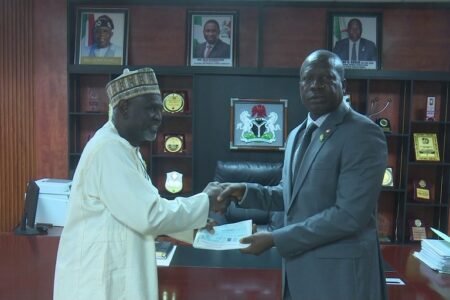
Minister of Humanitarian Affairs and Poverty Reduction, Bernard Doro, said the programme is designed to correct long-standing inefficiencies.
“We have been managing poverty, not ending it,” he said. “Nigeria does not lack interventions — it lacks systems.”
Tackling systemic poverty
Officials say over 63 percent of Nigerians face multidimensional poverty, driven by gaps in housing, healthcare, education, sanitation, and security.
The new system seeks to integrate humanitarian relief with long-term development and social protection, aligning efforts across ministries, state governments, and development partners.
Doro warned that failure to unify efforts could worsen the crisis, stressing the urgency of a coordinated national response.
Global concern over rising poverty
Representing the UN, Mohamed Fall described poverty in Nigeria as a humanitarian emergency rather than a gradual development issue.
“With 62 percent of Nigerians living in poverty and 33 million facing acute food insecurity, this requires immediate systems change,” he said.
The National Bureau of Statistics (NBS) also highlighted the scale of the challenge. Statistician-General Adeyemi Adeniran noted that about 133 million Nigerians are affected by multidimensional poverty.
He emphasised that no single institution can solve the crisis alone, calling for stronger collaboration across government, private sector, and civil society.
Data-driven approach
A key pillar of OHOPRS is the use of high-quality data for precise targeting and accountability. The NBS will support system interoperability, enabling seamless data sharing across agencies.
If successful, the programme is expected to not only deliver immediate relief but also build a long-term system capable of preventing future poverty shocks.