


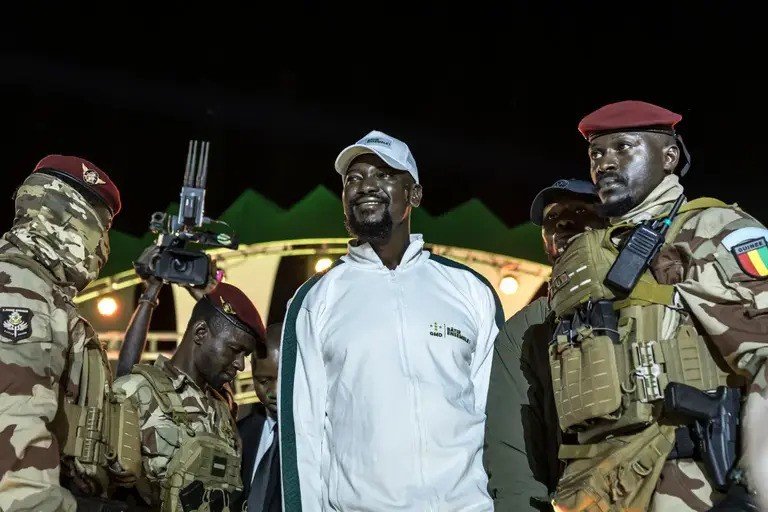
Guinea’s junta chief, Mamady Doumbouya, who had promised not to run for office after seizing power four years ago, has been elected president after securing a sweeping majority of the vote.
Doumbouya, 41, contended with eight opponents for the presidency, yet the primary opposition figures were prohibited from participating and had called for a boycott of the election conducted over the weekend.
In standing, the general broke his original promise not to seek office and to return the mineral-rich yet impoverished West African nation to civilian governance by the end of 2024.
He obtained 86.72 percent of the initial round of voting, as reported by the General Directorate of Elections, significantly exceeding the limit that would necessitate a runoff election.
According to Djenabou Toure, director of the General Directorate of Elections, voter participation was at 80.95 percent.
Doumbouya was significantly ahead in the districts of the capital, Conakry, frequently securing over 80 percent, based on official partial results announced by Toure earlier on RTG public television.
He maintained a comparable advantage in various other regions, including Coyah, a town close to Conakry, as well as in other areas of the nation like Boffa and Fria in the west, Gaoual in the northwest, northern Koundara and Labe, and Nzerekore in the southeast.
However, a citizens’ movement advocating for the restoration of civilian government questioned the statistic.
“A huge majority of Guineans chose to boycott the electoral charade,” the National Front for the Defence of the Constitution said in a statement Monday.
In September 2021, Doumbouya spearheaded a coup that deposed Guinea’s first freely elected president, Alpha Conde.
He has restricted civil freedoms and prohibited protests, while opponents have been jailed, tried, or forced into exile.
Candidate Abdoulaye Yero Balde criticized “serious irregularities,” citing in a statement late Monday the refusal to provide his representatives access to vote-counting centers as well as suspicions of “ballot stuffing” in some places.
Another candidate, Faya Millimono, complained of “electoral banditry” that was linked to voter influence.
In late September, Guineans accepted a new constitution in a referendum that allowed junta members to run for office, opening the path for Doumbouya’s candidacy.
It also increased presidential terms from five to seven years, renewable once.
Cellou Dalein Diallo, the opposition leader and former prime minister, was one of three opposition leaders forbidden from candidacy under the new constitution.
Diallo was excluded because he lives in exile and has his principal abode outside of Guinea.
Former President Conde, whom Doumbouya deposed in 2021, and ex-Prime Minister Sidya Toure, both of whom remain in exile, are over the age limit of 80.