


The Labour Party’s leadership crisis intensified on Monday, when the Julius Abure faction of the National Working Committee rejected reconciliation efforts by Abia State Governor Dr. Alex Otti, branding them as false and premature.
The Abure camp argued that the legal battle over the party’s leadership was far from done, accusing Otti of being responsible for the current crisis that is ripping the party apart.
In an exclusive interview with The PUNCH, the party’s National Publicity Secretary, Obiora Ifoh, rebuffed the reconciliation proposal and questioned its timing.
“We are not interested in any move by Abia State Governor Dr. Alex Otti to reconcile the party because he was the one who brought the crisis to the party in the first place,” Ifoh said.
“This reconciliatory thing he is throwing around is of no use. What we just witnessed was a judgment by a court of first instance. Why can’t he wait for the outcome of the appeal before deciding on such a move?
“Why is he suddenly in a rush to call for reconciliation? As far as we are concerned, their celebration is a pyrrhic victory. It will soon die down, and Nigerians will behold the true leadership of the party. Let him know that the battle is not over.”
The Abure camp’s strong stance demonstrates the depth of disagreement inside the party, notwithstanding recent court orders and the Independent National Electoral Commission’s recognition of the Nenadi Usman-led National Caretaker Committee.
The rejection came only hours after Otti openly expressed sadness for the party’s former presidential candidate, Peter Obi, calling his resignation a big setback for the Labour Party.
Otti addressed the meeting in Abuja with party Board of Trustees members, National Caretaker Committee leaders, and delegates from the Nigeria Labour Congress and the Trade Union Congress.
The meeting followed INEC’s decision to recognize the Nenadi Usman-led caretaker committee—a move earlier described by the Abure faction as hasty, prejudicial, and aimed at undermining the party’s leadership.
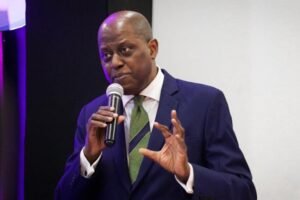
During the meeting, Otti said the new leadership had resolved to pursue reconciliation and rebuild internal cohesion following its court victory.
“We have decided that there is a need to set up a reconciliation committee,” he said. “The interim NWC will advise us on when to do so. The idea is to reconcile everyone who desires to return.
“We appeal to Julius Abure and his team to sheathe their swords and come back to the party. If they abide by the rules of the party, we will be happy to see them back.”
Otti also stated that the party would not participate in the forthcoming FCT council elections and ruled out joining any external opposition coalition ahead of the 2027 general elections.
“Labour is already a coalition—the coalition of Nigerian workers and progressive-minded people,” he said. “We have no plans to join another coalition.”
He praised INEC for complying with the Federal High Court’s decision to replace the Abure-led executives with the Nenadi Usman-led National Caretaker Committee on its website.
Meanwhile, Marcel Ngogbehei, Director-General of the Labour Party’s Directorate of Mobilization and Integration, accused Otti and Peter Obi of the ongoing conflict.
In an Abuja statement, Ngogbehei claimed Otti, the party’s most prominent elected official, failed to transform the momentum of the 2023 elections into long-term party structures.
“By sponsoring and legitimizing a caretaker committee, launched conspicuously in Abia State, Otti injected executive weight into an already volatile leadership dispute,” he said.
“Caretaker committees are not neutral instruments; they are factional weapons. Predictably, this entrenched parallel authorities, multiplied court cases, and accelerated the party’s legal disintegration.”
Ngogbehei also criticized Obi for failing to intervene firmly to unite the feuding factions.
“Obi remains the Labour Party’s most unifying symbol, yet he declined to impose moral authority or broker a compromise,” he said, adding that the former presidential candidate’s silence weakened party cohesion.
He cautioned that the ruling All Progressives Congress was profiting from opposition parties’ internal difficulties ahead of the 2027 election.
Despite Otti’s reconciliation efforts, the Abure faction’s resolute rejection indicates that the Labour Party’s leadership issue is far from resolved, with additional legal and political battles coming.