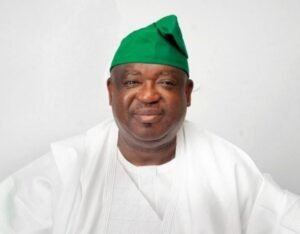





Justice Obiora Egwatu, on Thursday, stepped aside as the presiding judge over the Federal High Court’s asset forfeiture suit involving a former Attorney-General of the Federation, Abubakar Malami, SAN, and two others, citing personal reasons.
Egwatu informed the court he could no longer continue with the matter shortly after counsel for the parties announced their appearances.
“Ladies and gentlemen, for personal reasons, and for the better interest of justice, I will recuse myself from this case,” he said.
The judge directed that the case file be sent to the Chief Judge of the Federal High Court for reassignment.
“The instant charge CR/700/2025 filed FRN vs Abubakar Malami (SAN) and two others shall be filed back to the Chief Judge for further directives,” Justice Egwuatu told the court.
The recusal comes during a high-stakes legal battle over 57 properties valued at around ₦213.2 billion, which Justice Emeka Nwite ordered to be temporarily forfeited to the Federal Government last month.
The recusal comes during a high-stakes legal battle over 57 properties valued at around ₦213.2 billion, which Justice Emeka Nwite ordered to be temporarily forfeited to the Federal Government last month.
The portfolio includes university buildings, hotels, plazas, filling stations, residential estates, and significant swaths of property in Abuja, Kebbi, Kano, and Kaduna states, all of which the EFCC believes were illegally acquired.
Justice Nwite’s interim decision also required the EFCC to publish the notice in a national newspaper and allow any interested parties to show cause within 14 days why the properties should not be permanently forfeited.
Malami has, however, disputed the forfeiture judgment, claiming that his fortune was properly earned and completely revealed to the right authorities.
The former AGF sought the court to reject the proceedings, warning of “conflicting outcomes” and “duplicative litigation,” and claiming that the action infringed his property rights, presumption of innocence, and family life.
He further urged the court to prevent the EFCC from interfering with his ownership, possession, and control of three properties named 9, 18, and 48 in the EFCC’s motion, claiming that one of the properties is held in trust for his late father, Kadi Malami.