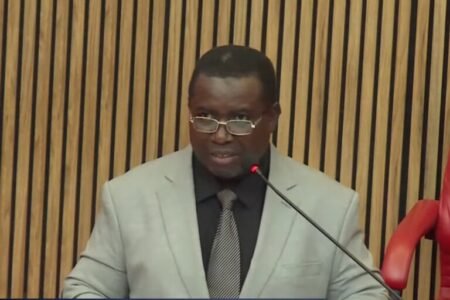




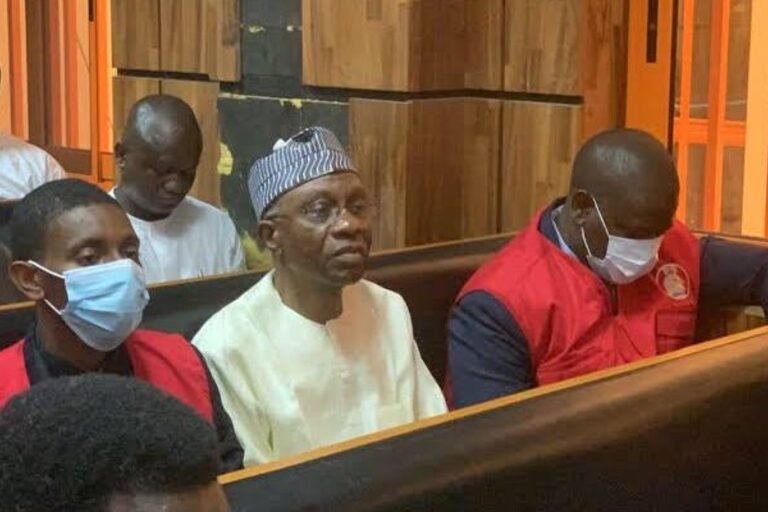
Alvan Gurumnaan, an operative of the Economic and Financial Crimes Commission (EFCC), says the agency did not force Henry Omoile, co-defendant of former Central Bank of Nigeria (CBN) governor Godwin Emefiele, to make statements.
Gurumnaan appeared before the Special Offences Court in Ikeja, Lagos, on Tuesday to testify in the trial-within-trial in the ongoing case involving Emefiele and Omoile.
Emefiele is standing trial on a 19-count charge bordering on receiving gratification and making corrupt demands while serving as CBN governor.
Omoile is facing a three-count charge bordering on the unlawful acceptance of gifts by a public officer.
One of the prosecution witnesses had earlier told the court that he routinely collected dollars in cash from some individuals for Emefiele and handed them to Omoile on the former CBN governor’s instructions.
During the October 9 proceedings, Rotimi Oyedepo, EFCC counsel, sought to tender Omoile’s extra-judicial statements as evidence.
However, Kotoye Adeyinka, counsel to Omoile, told the court that the statements were not voluntarily made.
As a result, trial judge Ramon Oshodi ordered a trial-within-trial to determine whether the statements were made under duress.
Tuesday’s Proceedings
At the resumed hearing on Tuesday, Gurumnaan, formerly of the special operations unit of the EFCC Lagos zonal command, narrated how Omoile made the statements inside the agency’s conference room at Block A, Awolowo Road, Ikoyi.
He said Omoile arrived at the EFCC office on February 26, 2024, accompanied by his lawyer, E. N. Offiong.
According to him, the defendant made four statements—three on February 26, 2024, and one on February 27, 2024.
The operative insisted that no officer coerced Omoile into making any statement.
“The second defendant did not make any statement under duress. Our officers do not force statements through violence or intimidation,” he said.
“The statements were signed by the second defendant. He even wrote, ‘I am making this statement in the presence of my lawyer, Offiong.’”
Gurumnaan told the court that Omoile’s lawyer was present on both days the statements were taken.
He tendered the EFCC visitors’ register as supporting evidence since the lawyer’s presence was not expressly stated in one of the statements.
During cross-examination, Gurumnaan admitted that no video recording was made while Omoile’s statements were taken, even though it is part of the EFCC’s standard procedure.
He explained that certain operational circumstances sometimes hinder video recording