



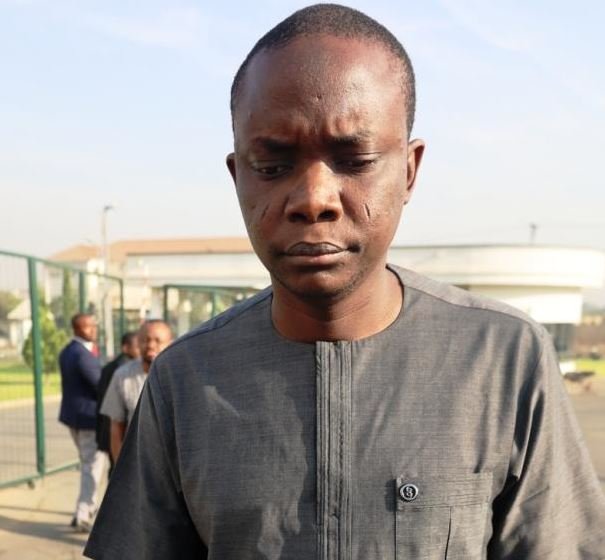
An Economic and Financial Crimes Commission (EFCC) witness on Monday linked a series of fund transfers traced to the Kogi State Government to Ali Bello, chief of staff to Usman Ododo, governor of the state, in the ongoing N10.2 billion fraud trial at the Federal High Court in Abuja.
Ahmed Abubakar, the 17th prosecution witness and an EFCC investigator, told the court that financial records recovered during the investigation detailed inflows and outflows allegedly connected to Bello and his co-defendant, Dauda Sulaiman.
Ali, a nephew of Yahaya Bello, former Kogi governor, and Sulaiman are standing trial on a 16-count amended charge bordering on alleged misappropriation and money laundering of N10,270,556,800.
Led in evidence by Rotimi Oyedepo, counsel to the EFCC, Abubakar identified Exhibit F as a document containing transaction entries uncovered during the investigation.
The witness said a $91,000 transaction dated February 5, 2021, was paid to “Oga Ali,” which he identified as a reference to Ali Bello.
He also cited a N150,000 outflow dated February 6, 2021, listed as payment to “Rashido.”
According to Abubakar, “Rashido” referred to Abdulrasheed, who allegedly travelled from Lokoja, the Kogi State capital, to move funds. He added that N150 million was transported from Lokoja to a bureau de change operator.
He further identified entries dated February 19, 2021, showing N10 million paid to Ali Bello and N500,000 to Sulaiman.
He told the court that references such as “Alhaji Ali” and “Daud” in the records corresponded to the first and second defendants, respectively.
On payments linked to account number 1000688500 belonging to Dantata and Sawoe Construction Company, the witness said transfers of N80 million and N20 million, totalling N100 million, were made in connection with Plot 1060 in Gwarimpa, Abuja.
“There were 10 entries of N10 million each, making a total of N100 million. The source is Maigari Murtala, an ally of the first defendant and a contact of the bureau de change operator,” he said.
The court admitted an irrevocable power of attorney for the property as Exhibit Q.
Proceedings were briefly halted when the prosecution sought to tender extrajudicial statements made by the defendants in November and December 2022.
Counsel to the defendants objected, arguing that the statements did not comply with Sections 15(4) and 17(2) of the Administration of Criminal Justice Act (ACJA), particularly regarding voluntariness and audio-visual recording.
After listening to arguments from both sides, James Omotosho, the presiding judge, ordered a trial within a trial to determine whether the statements were voluntarily made.
Testifying in the trial-within-trial, Abubakar insisted the statements were obtained without coercion.
“In EFCC, we have a standard: no threats, no promises, and statements were taken in the presence of their counsel, with Z.E. Abbas being the most present,” he said.
Following the mini-trial, the court admitted the statements into evidence after the defence raised no further objections.