



Beneath an escalating conflict between herders and farmers in central Nigeria lies a relentless but often under-reported force: history.
Events in the 19th century helped shape today’s violence between mainly Muslim Fulani cattlemen and largely Christian farmers — a battle of blood and identity.
Sokoto, an ancient city in northern Nigeria, is where many Fulani, a semi-nomadic people stretching from Lake Chad to the Atlantic coast, have their spiritual roots.
Cross-legged, his eyes closed and palms turned upwards to the heavens, Saidu Bello prays before a huge marble tomb covered in blue velvet: the resting place of Usman Dan Fodio, revered by many as a Muslim saint.
“I pray Allah to give me the same strength as he gave to the Shehu,” says Bello, a 29-year-old trader, referring to Fodio.
“Whenever I have doubts, I come here for his help to make the right decision.”
– Sokoto Caliphate –
In 1804, Fodio, a learned Fulani, declared holy war on despotic leaders.
Urging Muslims to observe a “pure Islam,” he launched an insurrection that, four years later, led to the establishment of the caliphate of Sokoto.
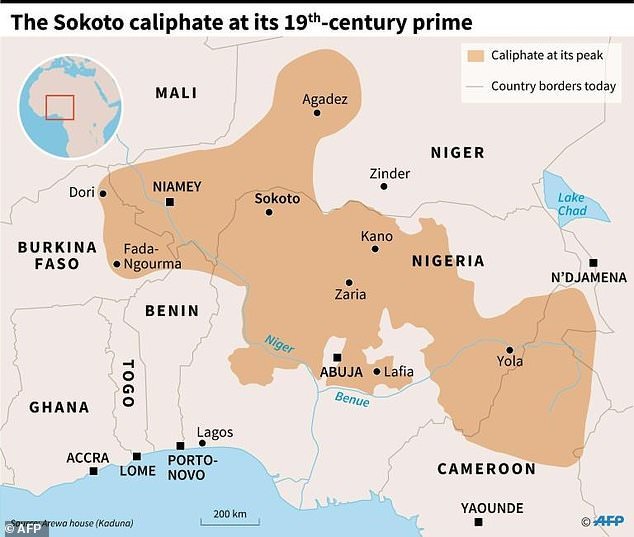
The state was as large as it was prosperous, extending from modern-day Burkina Faso to Cameroon — an area that took four months to cross end-to-end. The caliphate ended when its last leader was killed by the British in 1903.
“Usman Dan Fodio united former Hausa kingdoms and brought peace to the whole region,” says Sambo Wali Junaidu, advisor to the current sultan of Sokoto, a direct descendant of the first caliph and Nigeria’s highest-ranking Muslim.
READ: UN report indicates tramadol crisis in Africa
“He fought social injustices and undue privileges.”
Fodio’s charisma and writings — treatises and poems written in Arabic, Hausa and the Fula language — inspired Fulani jihads in West Africa throughout the 19th century.
And his popularity persists today. At the shrine in Sokoto, pilgrims come from as far as Senegal, laden with offerings.

Many of these faithful are barely-literate Fulani herders who have not read any of Fodio’s writings but learned of him through madrassas, or Islamic schools.
– Roots of conflict –
The conflict in Nigeria between Fulani and sedentary farmers has erupted in a fertile central region called the Middle Belt.
Demand for water and access to land, driven in part by a surging population in a country of 200 million, are among the contemporary causes for the fighting.
But there is a deeper reason: the Middle Belt lies in Nigeria’s religious faultline, between the predominantly Muslim north and mainly Christian south.
It is also a region that, historically, suffered chronic unrest.
Lying on the southern rim of the caliphate of Sokoto, the Middle Belt was largely populated by animist communities.
These were frequently raided by the caliph’s troops to provide slave labour for the plantations, salt mines or burgeoning iron industry which made the empire so prosperous.
Contemporary descriptions by traders are eye-opening. In 1824, in the great commercial hub of Kano, the ratio of the population was 30 slaves to every one free man.
“Native populations, living in this zone of influence during the time of pre-colonial Islamic empires, were psychologically scarred” by the raids and the enslavement, says Alioune Ndiaye, a specialist on Nigeria at the University of Sherbrooke in Quebec, Canada.
Many became Christian as a result, and the traumatic episode resonates in Nigeria today, he says.
“There is still this dread among people in the south that the northerners are coming ‘to dip the Koran in the ocean,’ as the saying goes,” Ndiaye says.
– ‘Blame the Fulani’ –
This backwash of fear and mistrust is often reflected in the Nigerian media, whose main outlets are owned by a southern tycoon.
Fulani herders are routinely called “terrorists,” and a supposed Fulani “plot” to Islamise Nigeria, begun under Fodio, is also media fodder.
Stigmatisation worsened after the election in 2015 of President Muhammadu Buhari, a Muslim Fulani from the north.
His every decision — from the speed with which he has condemned massacres to the response of the armed forces and the appointments he makes in the army and police — is scrutinised through the lens of ethnic bias, says Ndiaye.
Ibrahim Abdullahi, who represents an association of herders in the northern city of Kaduna, says the notion of a modern-day “Fulani jihad” is a “pure fantasy” that was being manipulated for political ends.
Unlike Mali and Burkina, where jihadist groups exploit ethnic resentment to recruit among Fulani people, the Fulani in Nigeria generally have no claims based on religious ideology.
“Most of the Fulani pastoralists are poor and haven’t been to school. They don’t have a voice, there’s no organisation or political elite speaking on behalf of all of them,” he said.
“That’s why each time something goes wrong in Nigeria, people blame the Fulani.”
This is an AFP Report