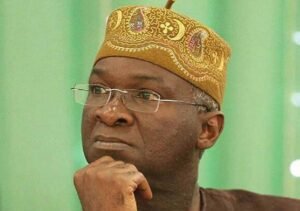




Former Lagos State Governor, Babatunde Fashola, has criticised former Vice-President Atiku Abubakar’s proposal to restore petrol subsidy if elected president in 2027, describing the plan as unrealistic.
Fashola challenged Atiku, the presidential candidate of the African Democratic Congress (ADC), to provide details of how he intends to implement and finance the proposed policy.
He argued that the former vice-president had yet to address critical challenges surrounding Nigeria’s crude oil production, security and the availability of petroleum products needed to sustain the arrangement.
Fashola made the remarks on Tuesday during an interview on Channels Television’s Politics Today.
He questioned the source of the crude oil required to supply domestic refineries, noting that Nigeria was yet to maximise its crude oil production quota because of persistent security challenges, vandalism and other longstanding problems in the oil sector.
“If we have refineries working, what is our current oil production quota? Are we optimising it yet? No, because there are legacy issues; there are challenges with security, vandalism, and so on and so forth, so where is this magic crude oil going to come from?” he asked.
The former minister insisted that Atiku needed to provide concrete evidence that his proposal was achievable rather than make promises without explaining how they would work.
“If he can explain, good, let people choose. But without proof, it is like abracadabra,” Fashola said.
Asked whether he considered Atiku’s proposal realistic, the former governor replied that it was not, stressing that his criticism was directed at the policy rather than the person proposing it.
“The proposal is not realistic. I am looking at the proposal, not the personality,” he said.
Fashola also questioned Atiku’s change of position on petrol subsidy, recalling that major presidential candidates, including the former vice-president, had supported subsidy removal during the 2023 presidential election.
He argued that Atiku needed to explain what had changed and why restoring the policy had become necessary.
According to him, bringing back petrol subsidy would require more than a presidential announcement, as legislative action would also be necessary to amend the existing legal framework.
He questioned whether lawmakers would be willing to support such a move, considering its implications for government revenue.
The former governor also drew on his experience in the administration of former President Muhammadu Buhari, warning that subsidy payments had previously deprived state governments of funds needed to meet their financial obligations.
“I was in a government that was paying subsidy. And the states were not getting money. So are we going to go back to partial, near-zero returns, states borrowing money to pay salaries? Is that where you want us to go?” he asked.
Atiku announced in August 2026 that he would restore petrol subsidy if elected president in 2027.
However, he proposed a temporary and audited arrangement tied to locally refined petroleum products rather than a return to the previous import-dependent subsidy system.
He argued that the proposal would reduce petrol prices, transportation costs and food prices while easing the financial pressure on Nigerian households.
President Bola Tinubu announced the removal of petrol subsidy during his inauguration on May 29, 2023, as part of his administration’s economic reforms.