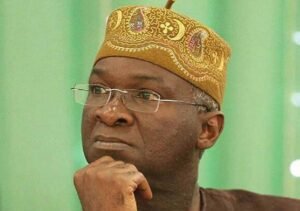



Former Lagos State Governor, Babatunde Fashola, has challenged opposition politicians to campaign on a promise to scrap the Nigerian Education Loan Fund (NELFUND), saying students and their families would resist such a move.
Fashola spoke on Tuesday during an appearance on Channels Television’s Politics Today, where he defended the student loan scheme introduced by President Bola Tinubu’s administration.
The former Minister of Works and Housing described NELFUND as one of the administration’s reforms that had helped ease the financial burden on Nigerian families.
NELFUND was established in April 2024 after Tinubu signed the Student Loans (Access to Higher Education) Act into law. The scheme provides interest-free loans to eligible students in tertiary institutions.
As of October 3, 2026, the fund had disbursed more than ₦372 billion to 1,635,676 beneficiaries across 312 tertiary institutions nationwide.
Speaking at an All Progressives Congress (APC) presidential campaign rally in Jigawa on November 10, Tinubu described NELFUND as a weapon deployed by his administration to tackle poverty, insisting that the scheme would not be discontinued.
Supporting the President’s position, Fashola said the initiative was designed to help Nigerian families cope with competing financial obligations, particularly rent, transportation, healthcare and education.
“This led to the creation of NELFUND to help families pay school fees and provide student allowances,” he said.
He noted that more than one million Nigerians were already benefiting from the scheme, adding that the number of beneficiaries continued to increase.
Fashola challenged opposition candidates to make scrapping the programme part of their campaign promises, saying beneficiaries and their families would resist such a decision.
“I challenge the opponents to promise to scrap NELFUND and see how beneficiaries and their families react. They won’t dare,” he said.
### Fashola speaks on Nigeria’s cost-of-living crisis
The former governor also addressed the rising cost of living, describing it as a global challenge whose effects were being felt in Nigeria.
He urged Nigerians to consider the factors contributing to the economic hardship, pointing to disruptions caused by the COVID-19 pandemic and subsequent global developments.
According to him, the pandemic disrupted economic activities worldwide, forcing governments to inject money into their economies to support businesses.
He said China, which he described as the world’s biggest production centre, took about two to three years to resume normal operations, contributing to supply shortages and rising prices.
Fashola also identified the Russia-Ukraine war as another factor that worsened the situation, citing disruptions to the supply of energy products such as diesel and food commodities, including wheat.
He said increased shipping costs and war-related insurance premiums further contributed to rising prices, although the impact varied among countries depending on their locations and levels of development.
“Thirdly, there was the unexpected war in the Middle East, which further worsened the situation,” he said.
Fashola added that the conflict had drawn renewed attention to the strategic importance of the Strait of Hormuz, with developments around the waterway influencing the cost of goods.
“Everybody now knows the Strait of Hormuz… even the tomato seller, and prices goods based on replacement costs,” he said.
The former governor also highlighted the Tinubu administration’s response to economic hardship, including the review of the national minimum wage and the consolidation of eight tax laws into four.