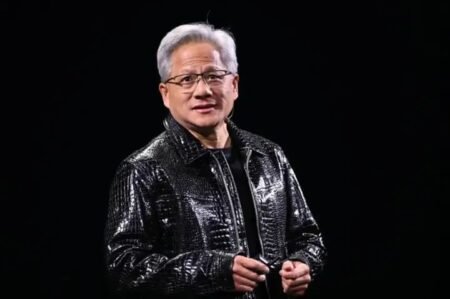



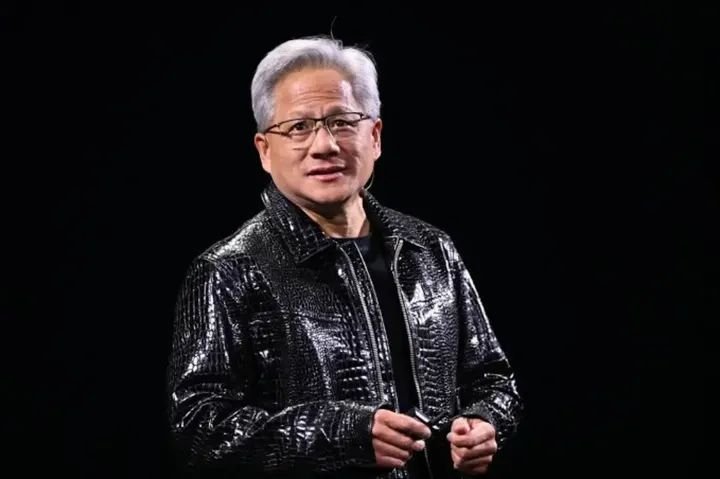
Jensen Huang resigned as chief executive of AI giant Nvidia on Thursday, the company announced, after revelations he had two extramarital affairs, including one with a woman accused of spying for China.
Chief financial officer Colette Kress will take over as interim CEO while the board looks for a permanent successor, bringing an end to Huang’s 33-year tenure leading the global powerhouse he co-founded.
Huang, 63, also stepped down from his board seat. The company did not provide a reason for his departure.
The scandal has driven shares of the multi-trillion-dollar company sharply lower, and the departure of Huang, a key promoter of the artificial intelligence boom, leaves Nvidia without its founding leader at a pivotal moment for the sector.
Nvidia shares fell more than 10 percent in premarket trading on Thursday after the announcement. The stock had already dropped about 25 percent from its all-time high in early October.
The board said it had named Harvey Jones, former chief executive of chip design software firm Synopsys, as its first-ever chair.
“The Board has full confidence in Colette and the leadership team, and we expect the company’s operations, customer commitments, and product roadmap to continue without interruption,” Jones said in a statement.
Kress said she was committed to “building on the extraordinary foundation Jensen created over the last 33 years.”
The scandal started with reports that Huang, married to Lori Huang for over 40 years, was engaged in an extramarital relationship.
On Sunday, Jensen Huang admitted to an affair, reportedly with Alice Huang, a former senior executive at Megaspeed, a data center company based in Singapore. The two are not related to each other.
This spring, US intelligence reportedly circulated a memo claiming that Alice Huang was an asset of China’s Ministry of State Security.
On Sunday, Nvidia’s board announced an investigation into what it described as a report that Huang had been the target of a “foreign intelligence effort,” while stating that it still had confidence in him.
On Wednesday, The New York Times reported that Huang had a second extramarital affair, citing video evidence of him being affectionate with Kimberly Powell, Nvidia’s vice president of health care.
Powell, 48, has been a public face of Nvidia’s push to expand its technology into higher education and health care. The Times reported that she was speaking at a conference in San Jose, California, where onlookers “were seen being affectionate at the hotel” with the two.
Nvidia’s code of conduct instructs employees to avoid conflicts of interest and gives “personal relationships” as an example.
Nvidia shareholders have filed a class action lawsuit against Huang and the company for failing to disclose information about the relationship to investors.
When the question came up, Huang had repeatedly declined to name a successor.
Kress became Nvidia’s finance chief in 2013, following almost 25 years in finance positions at companies such as Cisco and Microsoft.
Nvidia, founded in 1993, designs graphics processing units (GPUs)—components first developed to render 3D visuals in video games that have since become the foundation of AI systems.
Most of its processors are manufactured by the Taiwanese company TSMC, the largest contract chipmaker in the world.
Nvidia announced that it would publish its quarterly results on November 17, as planned.