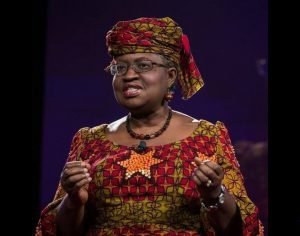





The Director-General of the World Trade Organisation (WTO), Ngozi Okonjo-Iweala, has recounted how investigating an alleged $2.4 billion fuel subsidy fraud in Nigeria led to threats against her and the kidnapping of her mother.
Okonjo-Iweala said the abductors demanded that she resign as finance minister and leave the country in exchange for her mother’s release.
She recounted the ordeal during an interview with Bloomberg’s Francine Lacqua on The Leaders programme, published earlier this week.
The former finance minister said the investigation began after officials noticed a sharp increase in claims submitted by fuel importers under Nigeria’s subsidy programme.
At the time, Nigeria relied on imported refined petroleum products to meet domestic demand despite being an oil-producing country.
Under the subsidy arrangement, importers received government payments that enabled them to sell petrol at regulated prices. However, Okonjo-Iweala said the amounts being claimed had risen to suspicious levels.
“So I went to the president and said, look, something is going on here. Could we audit the accounts? And he said, yes, go ahead. And we found about $2.4 billion worth of fraud. So we refused to pay,” she said.
Okonjo-Iweala recounts threats, mother’s kidnap
Okonjo-Iweala said the decision to withhold the disputed payments triggered threats against her before her mother was abducted.
“I was told that for her to be released, I should resign and leave the country,” she said.
She described the five-day ordeal as one of the most painful periods of her life, saying she feared that her actions could lead to her mother’s death.
“It was a terrible, terrible five-day ordeal. I think the worst in my life,” she said.
According to the WTO chief, her mother was held in a forest before escaping one night.
“She was held in the middle of a forest, and one night she escaped. She’s still alive. She’s 96 now,” she said.
Okonjo-Iweala added that her mother still becomes distressed whenever the incident is mentioned.
‘I would pick my mother any day’
Asked whether she had considered quitting her job during the crisis, Okonjo-Iweala said she would have chosen her mother’s life over remaining in office.
“Between my mother, having my mother alive and staying in a job, I would pick my mother any day,” she said.
However, she recalled that her father urged her not to give in to the kidnappers’ demands.
“He said, we don’t give in to blackmail. And he said, you’ve got to carry on. You’ve got to go to work,” she recounted.
Okonjo-Iweala said she initially felt paralysed by fear and considered resigning to secure her mother’s release. She added that the experience left her with a sense of guilt that she still carries.
“I never dreamt my parents could ever be touched in this way, that people would be that evil,” she said.
She also said her experiences over the years had made her more patient and helped her concentrate on finding solutions when confronted with difficult situations.
‘Every single penny counts’
Reflecting on the need to tackle financial misconduct, Okonjo-Iweala said countries with limited resources could not afford to lose public funds.
“I feel that this is a real fight that has to be waged. If you are a country that is not that rich, every single penny counts,” she said.
Okonjo-Iweala served as Nigeria’s finance minister under former President Goodluck Jonathan before becoming WTO director-general in March 2021.
Her mother, Kamene Okonjo, was kidnapped from her home in Ogwashi-Uku, Delta State, in December 2012.
The incident attracted national attention amid concerns about the safety of the finance minister’s family.