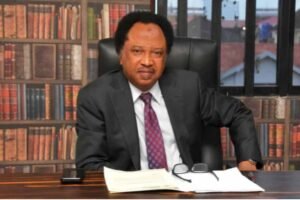





Former Kaduna Central senator Shehu Sani has expressed confidence that President Bola Tinubu will win the 2027 presidential election, arguing that respecting power rotation and allowing the South to complete its term are crucial to Nigeria’s political stability.
Sani also defended Tinubu’s re-election bid, criticised what he described as selective outrage over insecurity and urged Northern politicians to prioritise competent representation.
In an interview with Chronicle NG’s Northern Bureau Chief, Muhammad Sabiu, the former lawmaker explained why he wants to return to the Senate, discussed the agitation for power to return to the North and outlined his position on Kaduna State’s political future.
Why Shehu Sani wants to return to the Senate
Sani said his decision to seek a return to the National Assembly was driven by the need to represent his constituents, protect their interests and attract federal development projects to Kaduna State.
He argued that Northern Nigeria needed experienced and vocal legislators capable of influencing national debates and addressing the region’s challenges in education, healthcare and development.
According to him, the region must elect competent representatives who can effectively project its interests at the federal level.
Sani criticised the current senator representing Kaduna Central, claiming that the lawmaker was not among Nigeria’s top 20 senators and was rarely heard on the Senate floor or seen in the constituency.
He cited his previous tenure as evidence of what he could achieve, saying he facilitated the construction of seven to eight primary healthcare centres, provided scholarships, supported education and women’s empowerment initiatives, and attracted federal projects.
The former senator added that disagreements between the National Assembly and the administration of former President Muhammadu Buhari had affected the delivery of projects during his previous tenure.
He expressed optimism that a better working relationship with Kaduna State Governor Uba Sani and President Tinubu would enable him to attract more development to the state if re-elected.
Shehu Sani compares insecurity under Jonathan, Buhari and Tinubu
Sani said insecurity had remained a major challenge in Northern Nigeria for more than a decade, citing attacks, kidnappings, killings and the destruction of communities by bandits and terrorist groups.
He referenced Boko Haram, the Islamic State West Africa Province (ISWAP) and other armed groups operating in the North-East, alongside banditry and mass abductions across several north-western and north-central states.
The former lawmaker recalled that former President Goodluck Jonathan faced intense criticism over insecurity, including the 2014 abduction of schoolgirls from Chibok, Borno State.
He subsequently listed several school attacks and mass kidnappings recorded under Buhari, including incidents involving schools in Dapchi, Jangebe, Kagara, Yauri and Kaduna State.
Sani argued that many people who criticised Jonathan remained silent when similar security challenges persisted under Buhari, whom he said benefited from ethnic, sectional and religious loyalties.
He also listed several senior security officials who served under Buhari and argued that their failure to contain insecurity did not attract comparable public condemnation.
“Nobody says Tinubu has solved all security problems in Nigeria,” Sani said, acknowledging that kidnappings, terrorism and banditry continued under the current administration.
However, he rejected what he described as attempts to blame Tinubu for insecurity while excusing the previous administration, arguing that political and ethnic considerations had influenced public reactions.
Sani maintained that security challenges should be assessed consistently, regardless of the political party or region of the president in office.
Why Shehu Sani wants power rotation respected
On calls for presidential power to return to Northern Nigeria in 2027, Sani defended the principle of rotational presidency, arguing that the South should be allowed to complete its turn before power returns to the North.
He questioned the level of Northern support for former Vice-President Atiku Abubakar in previous presidential elections, asking why the region had not consistently voted for him when he contested against Olusegun Obasanjo, Umaru Musa Yar’Adua, Goodluck Jonathan, Buhari and Tinubu.
Sani said Nigeria’s political stability depended partly on respecting the rotation of power between the North and South.
He called on former Rivers State governor Rotimi Amaechi to contest under the African Democratic Congress (ADC), Peter Obi to run under the Nigeria Democratic Congress (NDC), and Tinubu to seek re-election under the All Progressives Congress (APC).
“Let the South finish its own four years, and then power can return to the North in peace,” he said.
According to Sani, disrupting the arrangement could trigger fresh political agitation in the South-West, South-East and South-South.
He also argued that the current political climate had reduced agitation for separatist causes, including Biafra and the proposed Oduduwa Republic, because some groups believed they had a stake in the presidency.
Sani further accused some Northern political actors of exploiting economic hardship and public dissatisfaction to mobilise opposition against Tinubu.
He argued that promises to restore fuel subsidies were inconsistent with Tinubu’s long-standing economic ideology, which he described as supportive of market-oriented reforms, privatisation and reduced government control of the economy.
Sani expresses confidence in Tinubu’s 2027 re-election bid
Sani said he was confident that Tinubu would win the 2027 presidential election, adding that he expected the APC to perform strongly in Kaduna State.
He argued that Kaduna’s multi-ethnic and multi-religious character made it different from other states and said political strategies based on ethnic or religious sentiment would not necessarily succeed there.
The former senator also criticised the administration of former Kaduna State governor Nasir El-Rufai, alleging that it had sacked thousands of workers and teachers, demolished homes and jailed critics.
He cited the experiences of journalists, traditional rulers, Islamic clerics and community leaders whom he said faced detention or prosecution during El-Rufai’s tenure.
Sani argued that political leaders should respect freedom and the rule of law, warning that public office was temporary.
He also maintained that political representation should not be built on religious or ethnic exclusion, particularly in a constituency where, according to him, Christians account for about 45 per cent of the population and Muslims 55 per cent.
What Shehu Sani says Kaduna needs
Sani said effective representation required more than political slogans, insisting that lawmakers should attract development, defend constituents and ensure that federal resources reached their communities.
He maintained that Kaduna needed representatives capable of engaging constructively with the state and federal governments while remaining prepared to speak out when necessary.
The former senator’s comments come as political parties and aspirants position themselves ahead of the 2027 general elections, with debates over security, economic reforms, regional representation and the rotation of presidential power expected to remain central to the campaign.