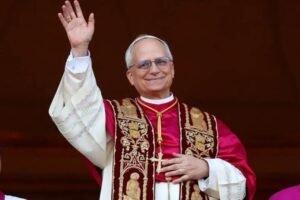


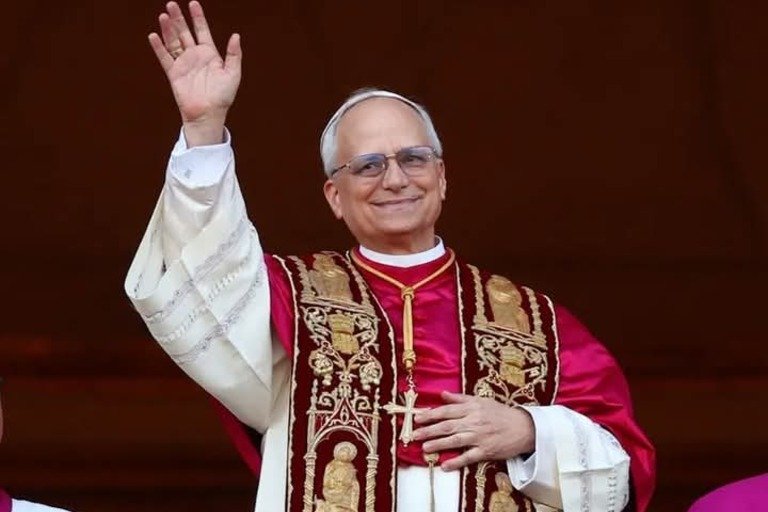
The Vatican said in a medical bulletin that Pope Leo XIV has been diagnosed with lung cancer but successfully underwent surgery to remove the lower lobe of his right lung.
The 71-year-old had 90-minute surgery on Tuesday at Rome’s Gemelli Hospital and was later diagnosed with lung adenocarcinoma, a type of cancer typically found in the outer part of the organ.
“The operation was successful and there were no complications,” the Vatican said.
“After the operation, the Pope awoke normally and returned after a brief period of observation to his room.”
The Vatican announced on Wednesday morning that the pontiff had a “peaceful night” in the hospital, and he is anticipated to stay there for roughly a week.
On Tuesday, large crowds had gathered outside the hospital awaiting the Pope’s arrival, cheering as he waved and smiled through a window while his car drove past.
Staff greeted him on the hospital steps. “I’m sorry,” one of them said in sympathy, and the Pope responded with a smile and a shrug.
According to the Vatican, the entire lower lobe of the Pope’s right lung was removed during a surgery lasting about 90 minutes “to ensure the procedure was radical.”
It was Leo himself who announced news of his operation to the world on Sunday during his weekly Sunday prayers, informing the crowd in St. Peter’s Square that doctors had discovered a nodule in his lung.
He assured pilgrims that the mass was “well-contained” and detected “at an early stage,” but that his doctors had recommended removing it.
Nodules are fairly common and not always cancerous, but after examination the medical team confirmed it was “as suspected by preoperative tests,” according to the Vatican.
A Vatican source told news agency AFP that additional tests were now under way to determine whether the cancer had spread.
The Vatican has emphasized that the Pope, who is generally regarded as fit, showed no symptoms of infection or illness.
Cardinal Kikuchi Tarcisio Isao of Tokyo said he had met with the pontiff on Monday and had sensed “nothing wrong” physically.
He said the Pope whose schedule has been cleared until 20 October so he can recover had chosen to check in for surgery as soon as possible because he was eager not to postpone a planned trip to Latin America in early November.
The trip is especially significant since it includes a visit to Peru, where he served as a missionary and later a bishop for many years.
Despite all the reassurances, the news has unsettled Catholics around the world—many of whom will recall Pope Francis’s recent hospital visits.
Leo’s predecessor, who died last year, also had part of his lung removed when he was young, before enduring a series of respiratory infections later in life.
“Am I worried? Yes, because I certainly wasn’t expecting anything like this,” Vatican Secretary of State Cardinal Parolin told journalists on Tuesday.
He said that although the news had come as a “bolt from the blue,” the cardinals had been impressed by the Pope’s “serenity” and felt sure he would recover.
After the pontiff was admitted to Gemelli Hospital, which has cared for several popes, a handful of Catholics stayed outside, eager to remain nearby.
“He seems calm, so we are calm too—even though illness is always unpleasant,” Carla told the BBC. “We will wait here and pray.”
“I was in St. Peter’s Square when he made the announcement, and I felt really awful,” said Elsa. She had thought he was a younger, healthier Pope and had been “really taken aback” by the news.
Elise Ann Allen, the author of a biography on the Pope, told the BBC that it would be “premature to be alarmed, but it’s also premature to say everything’s fine.”
She encouraged people to hold off on drawing conclusions until they hear from his doctors, saying on the World Service’s Newsday program, “We don’t know how much of a crisis it is at this point, but it’s certainly a scare.”
Following the Pope’s diagnosis, it came to light that his brother, Louis Prevost, was also undergoing treatment for a different cancer—multiple myeloma, a form of blood cancer.
In the northern Peruvian city where the Pope—known then as Robert Prevost—served as bishop for eight years, locals are praying for his quick recovery.
Chiclayo is anticipated to be among the most emotional stops on the pontiff’s tour of Latin America.
Just a day before the Pope, who holds Peruvian citizenship, disclosed his surgery, officials had announced that they expected 1.5 million people to travel there to see his return.
“God willing, we will have him here, because these preparations have been going on for several months—not just on a practical level, but also on a spiritual one,” one retired journalist told AFP.
Archbishop Richard Moth, the Catholic leader of the UK, voiced “gratitude and relief” that the Pope’s operation had gone well.
Adenocarcinomas form in the cells that make mucus and rank among the most frequently seen forms of lung cancer.
Long-term prospects hinge on several factors, such as the stage at which the cancer is found and the patient’s general state of health.
The sooner it is detected, the better, and treatments have advanced over the past few decades.
Certain adenocarcinomas are detected early before symptoms appear through routine testing. Once lung cancer reaches later stages, it can lead to a persistent cough, breathlessness, fatigue, and weight loss.