



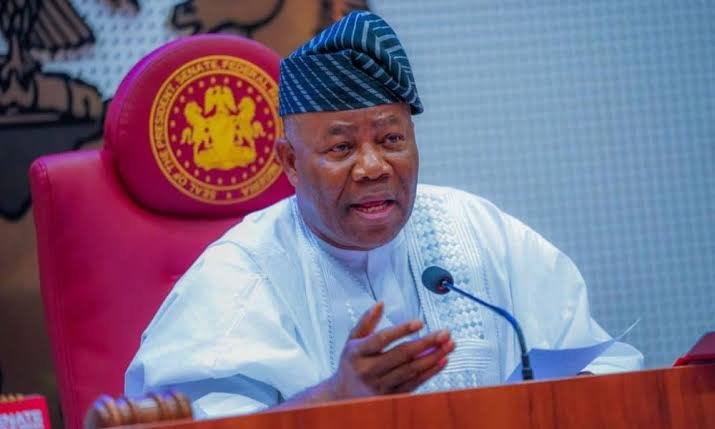
Senate President Godswill Akpabio has opposed a bill seeking to decriminalise attempted suicide in Nigeria, insisting that survivors should face imprisonment under existing laws.
Akpabio spoke on Tuesday during debate on the Suicide Prevention Bill 2026, sponsored by Asuquo Ekpenyong, senator representing Cross River South.
The proposed legislation seeks to replace criminal punishment for attempted suicide with medical treatment, rehabilitation and other support services.
Despite Akpabio’s opposition, the Senate passed the bill for second reading, allowing it to proceed to further legislative consideration.
Akpabio Insists Attempted Suicide Should Remain a Crime
During the debate, Akpabio maintained that attempted suicide should remain a criminal offence under Nigeria’s existing laws.
“As far as we are concerned, we are saying that suicide is a crime for now. Therefore, if you attempt it, you better succeed. If you don’t succeed, we will send you to prison,” he said.
The Senate president reiterated his opposition, noting that the chamber had yet to hold a public hearing on the proposed legislation.
“If you attempt it and don’t succeed, we will jail you. So, if you attempt it, you better succeed,” he added.
Ekpenyong Seeks Shift From Punishment to Treatment
Presenting the bill, Ekpenyong argued that Nigeria’s legal framework was inconsistent because the National Mental Health Act recognises attempted suicide as a psychiatric emergency requiring immediate intervention, while the Criminal Code and Penal Code continue to criminalise the act.
“Our law presently speaks with two voices. The National Mental Health Act recognises attempted suicide as a psychiatric emergency requiring immediate intervention,” the lawmaker said.
“Yet section 327 of the Criminal Code and section 231 of the Penal Code continue to expose the same person to criminal punishment.”
He warned that criminalising attempted suicide could discourage people experiencing suicidal thoughts from seeking help. It could also cause families to conceal suicide attempts for fear of prosecution or stigma.
“Criminalisation can discourage people from disclosing suicidal thoughts or seeking help. It may cause families to conceal attempts, health workers to avoid complete reporting, and communities to treat a medical emergency as a source of shame,” he said.
Ekpenyong urged lawmakers to reconsider how the state responds to people who survive suicide attempts.
“At the heart of this bill is a simple question: When a Nigerian survives a suicide attempt, should the first response of the state be prosecution or protection?” he asked.
He said passing the bill for second reading would affirm suicide prevention as a national public health responsibility and support a treatment-focused approach to people experiencing psychological distress.
“By supporting its second reading, this senate will affirm that suicide prevention is a national public health responsibility, and that a person in acute distress should be helped to recover rather than punished for surviving,” he said.
The senator also stressed that decriminalising attempted suicide would not amount to endorsing suicide or excusing anyone who encourages or assists another person to take their own life.
“Decriminalising an attempt does not legalise or encourage suicide. Neither does it excuse anyone who procures, encourages, or assists any other person to take his or her life,” he said.
He added that removing criminal penalties alone would not be enough without accessible mental health services, noting that suicidal behaviour often arises from complex circumstances requiring compassionate, health-focused intervention.
Senators Raise Legal Concerns
Ned Nwoko, senator representing Delta North, seconded the motion for the bill’s second reading but questioned how the proposed legislation would effectively prevent suicide.
He asked Ekpenyong to clarify the bill’s objectives and the practical measures it proposed to prevent people from taking their own lives.
Other senators supported the proposal, arguing that suicidal behaviour could be associated with depression and other mental health challenges requiring professional intervention.
Senate Leader Opeyemi Bamidele raised concerns about the legal implications of amending the existing criminal justice framework, particularly the application of federal legislation across the states.
He noted that the Administration of Criminal Justice Act requires adoption by state Houses of Assembly for application within their respective jurisdictions. He urged lawmakers to examine the legal implications carefully to ensure the proposed reforms would achieve their intended purpose.
Abdul Ningi, senator representing Bauchi Central, commended Ekpenyong for introducing the bill, describing suicide prevention as an important issue requiring wider public and professional debate.
Ningi said the bill’s second reading would provide an opportunity for medical professionals, legal experts and other stakeholders to contribute to discussions on preventing suicide and supporting survivors.
He also argued that people who attempt suicide should not automatically be regarded as criminals without considering the circumstances surrounding their actions.
Bill Proposes Crisis Helplines and Rehabilitation
The proposed legislation seeks to establish a national framework for suicide prevention, early intervention, medical treatment and long-term support for survivors.
Its provisions include crisis helplines, medical assessments, referral services, rehabilitation and follow-up care for people who survive suicide attempts.
The bill also seeks to promote public awareness and train police officers, teachers and healthcare workers to improve suicide prevention and response.
In addition, it proposes establishing a national data system to strengthen suicide prevention efforts.
Under the proposed framework, survivors would receive appropriate medical assessment, treatment and continuing support rather than face imprisonment for attempted suicide.
Following the debate, the Senate passed the bill for second reading and referred it to the relevant judiciary and health committees for further legislative consideration, including a public hearing.