




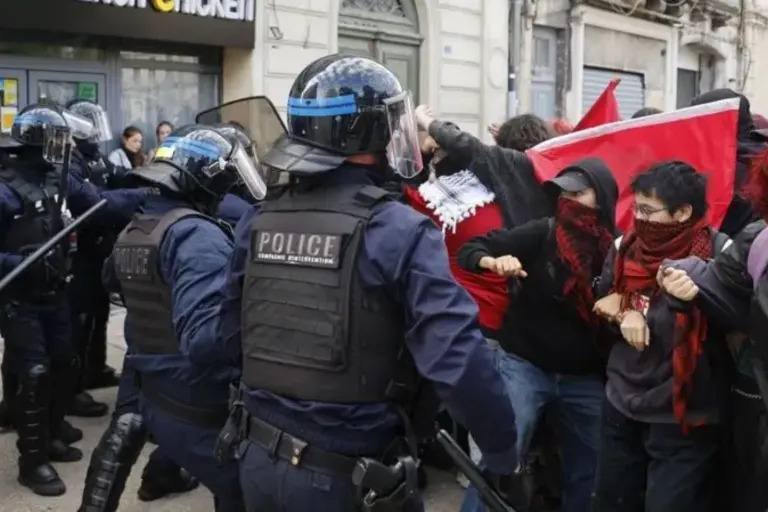
Riot police clashed with demonstrators on Friday in France, where thousands of students protesting education standards caused disruption at more than 700 schools.
Fires burned in the streets as high school students and others voiced their opposition to a shortage of teachers, overcrowded classrooms, and dilapidated buildings.
The protests started in Paris last week and have since spread throughout the country, affecting cities such as Montpellier, Nantes, and Marseille.
French justice minister Gerald Darmanin said the situation had “gone from high-school student demonstrations to a public order disturbance.”
On Friday, a 17-year-old was arrested on suspicion of attempted homicide following protests in Belfort, north-eastern France, where a police officer was targeted.
The education ministry said at least 65 staff members had been injured in the unrest.
In the Paris suburb of Pantin, police charged at protesters and carried out arrests after projectiles were thrown at officers.
Meanwhile, according to the Reuters news agency, tear gas was used in Strasbourg as police feared the situation would turn more hostile.
Rubbish bins have also been set on fire in Rennes and Paris.
“As far as we’re concerned, we’ve won—our school is closed this morning,” Lola, a 16-year-old protester, told the AFP news agency on Friday.
She said the police’s actions had only made matters worse.
“It makes us even angrier the police have no right to hit us or use tear gas on us,” she added.
Police released images of some of the items seized from demonstrators, among them petrol bombs, an axe, and so-called mortar fireworks.
The education ministry said “significant damage” had been caused to school facilities following attacks on school gates, entrances, and fences.
According to the regional government, Nelson Mandela High School in Nantes sustained more than €2m (£1.7m) in damage after a fire destroyed its glass entrance and some areas inside the school.
The blockades and protests began last week before spreading to hundreds of schools nationwide.
Students complain that school hours are too long, classrooms are too hot, and too many staff members are off work.
This comes at a critical moment for French President Emmanuel Macron, six months ahead of next year’s presidential election.
Planned budget cuts, which will affect education funding, have enraged the young protesters.
French Education Minister Édouard Geffray said on Friday that the movement had been hijacked by non-students.
He told the French broadcaster BFMTV that teachers had remarked, “The people in front of me were not my students.”
Parents have also been concerned that their children have gotten swept up in a surge of violence and unrest.
At the Claude Monet school in southern Paris, 53-year-old Anya was searching for her son.
“We banned him from coming. I hope he isn’t here, but he did leave the house,” she told AFP. “We’re afraid the situation might escalate.”
Darmanin, the justice minister, said prosecutors had been instructed to hold parents accountable for damage caused by their children and to “pay for repairs.”
He said that since the movement began, roughly 2,000 people—most of them children—had been taken into custody.
Many French unions have voiced their support for the protesting students.
The education union SNEP-FSU, the public services union SNUEP-FSU, and Solidaires have all urged members to support them.
The Solidaires Trade Union Federation said in a statement, “Let’s not let them fire on our children.
“Secondary school pupils have the freedom of assembly, association, and demonstration.”