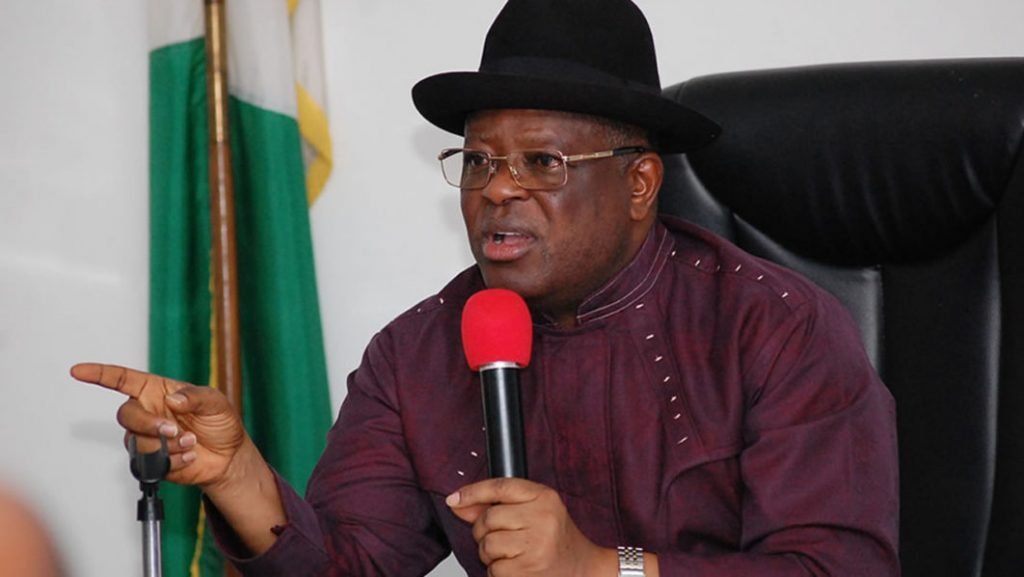



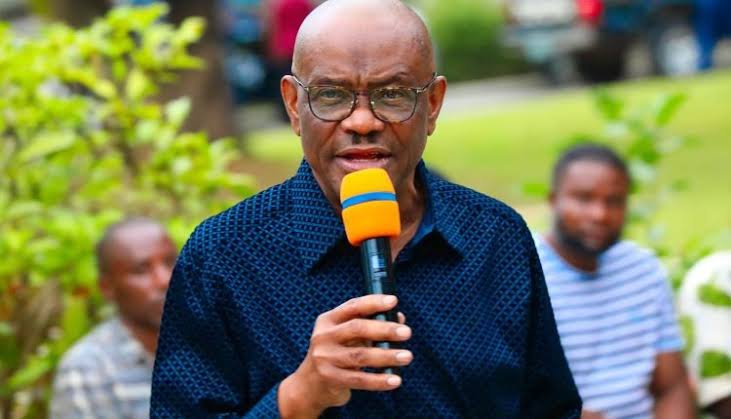
The Minister of the Federal Capital Territory, Nyesom Wike, has rejected claims that he manipulated the 2023 presidential election in the South-South to favor President Bola Tinubu over the Labour Party candidate, Mr. Peter Obi.
Speaking to journalists in Abuja on Wednesday, Wike dismissed the allegation as a “baseless narrative propagated primarily on social media.”
According to the News Agency of Nigeria, his comments during an interview on TVC’s Journalists’ Hangout, where he said his G5 group of governors deliberately let Obi win in parts of the South-South triggered widespread criticism across the political landscape.
Critics, public commentators, and opposition figures contended that Wike’s remark amounted to a public admission of voter manipulation.
In response, Wike explained that the results stemmed from a deliberate electoral strategy designed to neutralize major political threats, not from illegal manipulation.
Answering critics who accused him of tampering with result sheets to favor Tinubu, Wike questioned how one person could single-handedly determine the outcome across thousands of polling units.
“People who don’t understand, how can they say I rigged the election? How would I have done it? So, I just took the result sheets, wrote it, and gave it to INEC?” he asked.
He stressed that social media projections often fail to reflect the reality across the country’s vast voting infrastructure.
“I’ve always said social media does not win elections. You have about 176,000 polling units, and probably you have seen 300 polling units, and then you rush to the conclusion that so-and-so has won.
“Election outcomes are not predicted this way,” he said.
Wike also mentioned that, in spite of the public outcry following the election, opposition parties failed to substantiate claims of rigging in court.
“You remember that when they went to the tribunal, did anybody tender any result from Rivers to say, ‘Look, this is the result; we won’?” he added.
Giving details on the tactical approach adopted in the South-South, traditionally a stronghold of the Peoples Democratic Party (PDP), Wike explained that PDP presidential candidate Atiku Abubakar was identified as the primary threat to their political coalition, known as the G5.
Wike explained that to stop Atiku from winning the region, their plan was to direct votes toward Peter Obi in certain areas, thereby splitting the opposition base and reducing Atiku’s margin.
“We felt that Atiku was more of a factor in that election than Obi. So our strategy was to make sure that you vote for Obi to win in order to deny Atiku the votes.
“South-South was purely a PDP state, and so if we had voted for PDP all through, then Atiku would have won. That was a threat,” he said.
The minister minimized Obi’s wider national momentum, pointing out that strategic planning demanded a focus on concrete figures rather than internet fame.
“Obi wasn’t a threat. Obi was merely a threat by social media. Even if Obi had secured Rivers outright, it would not have altered the outcome of the presidential race.
“Assuming Obi won Rivers, add it for him. Would he have won the election?” he asked.
Wike also stated that attempting to manipulate an election without genuine grassroots popularity was impossible in Nigeria’s current political landscape.
“When you talk about rigging, you cannot rig an election where you are not popular. You cannot. If you try that, then you see what will happen to you. People will resist it,” he added.
Wike called on political analysts and the public to concentrate on how elections work and on verified facts, instead of paying attention to online commentary.
“We had our strategy, and that strategy worked well for us.
“Our major opponent was Atiku Abubakar, and if we didn’t do that, something would have happened,” he said.