



Award-winning filmmaker and author, Omoba Deji Adesanya, has launched a 584-page book documenting the history, politics, economy, culture, education, traditional institutions and notable personalities of Sagamu, Ogun State.
Titled A Handbook of Sagamu, the book was publicly presented on Thursday, August 27, 2026, at the Centenary Hall, Ewusi Street, Sagamu.
The event attracted traditional rulers, community leaders, business personalities, professionals and other distinguished guests.
Adesanya said the book was inspired by his desire to properly document Sagamu’s rich history and make it accessible to present and future generations.
The Chairman and Father of the Day, Asiwaju S.K. Onafowokan, OON, described the publication as an important contribution to preserving Sagamu’s history and identity.
Speaking at the event, Onafowokan said: “a city or town that does not know its history is like a town without direction.”
He commended Adesanya for undertaking what he described as a painstaking research project, noting that the author interviewed several community leaders and carried out extensive documentation.
According to Onafowokan, the book “captures where we came from, the sacrifices of our forebearers, the inevitable wars, our peace bridges and our festivals, heroes and heroines, and how we finally landed where we are as Sagamu indigenes that we are proud of today.”
He said the publication would be particularly useful to young people, Sagamu indigenes in the diaspora, researchers and investors seeking to understand the community’s roots, culture and social development.
Onafowokan also praised Adesanya for completing the project despite not being a professional historian.
“Despite not being a historian, he was able to achieve this milestone, which our historians ought to have preached,” he said.
He urged schools, universities, libraries, homes and Sagamu indigenes in the diaspora to embrace the book as a reference material.
Representing the Akarigbo and Paramount Ruler of Remo Land, HRM Oba Babatunde Ajayi, CFR, Oba Adewale Adeniji also commended Adesanya for researching and documenting Sagamu’s history.
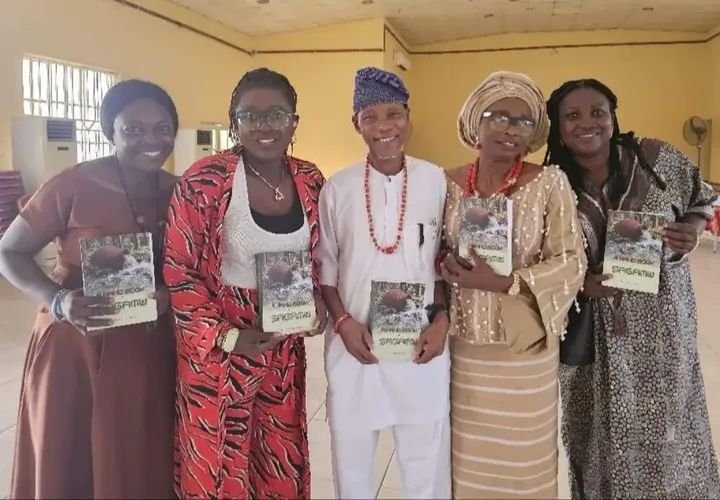
“It is good for us to have somebody like Deji Adesanya in the family,” Adeniji said.
Sagamu’s notable sons and daughters
One of the book’s major features is its documentation of accomplished individuals who have contributed to Sagamu’s prominence in Nigeria and internationally.
Those profiled include Emeritus Professor T.O. Ogunlesi, Nigeria’s first Emeritus Professor of Medicine; Bayo Ogunlesi, Ph.D., a globally accomplished businessman and investment banker; Prince (Dr.) Adegboyega Adedoyin, famed as the first Nigerian to compete in an Olympic Games final; and Falilat Ogunkoya-Omotayo, the first Nigerian to win an individual track and field medal at the Olympic Games.
Others include music star Dapo Oyebanjo, popularly known as D’banj; former Ogun State Governor and Ogun East Senator, Otunba Gbenga Daniel; Surveyor Ebenezer Ademola Olusesi, Nigeria’s first licensed chartered surveyor; Bola Oyesanya, the first Nigerian to serve as Managing Director and Global Head of the Law Firm Group at JPMorgan; and veteran Nollywood actor Kunle Bamtefa.
How the book began
Adesanya said the idea for the book had been in his mind for more than two decades.
He traced the inspiration to around 1999, when he came across a newspaper publication titled “Who Is Who of Kwara”.
“I said to myself, okay, why don’t I write Who Is Who of Sagamu, not of the state,” he recalled.
The idea later developed after his mother gave him a book about Ikenne titled A Handbook of History of Ikenne, written by Soriyan.
“My mum now gave me a book called A Handbook of History of Ikenne, written by one Soriyan. I looked at it and said, okay, well, yeah, I think I would like something like this,” he said.
Adesanya said he was particularly interested in how the Ikenne publication examined areas beyond history, including the local economy and profiles of notable people.
He also recalled an earlier book on Sagamu written by Chief Ayodele but decided to expand the scope of existing documentation.
“I said to myself, history is nothing, you know, I already have an idea of the history of Sagamu, so why don’t you expand it?” he said.
He subsequently researched Sagamu’s politics, economy, governance, education and health practices, among other subjects.
Traditional governance and local history
Adesanya said his research also examined Sagamu’s traditional governance system and how it operated before Nigeria’s post-colonial administrative structure.
“Today, in this post-colonial system that we are operating, the local government chairman is the head of any community,” he said. “Then Oba was like the supreme.”
He explained that the Oba traditionally served as both the spiritual and political head, working with institutions including the Oba-in-Council and civic associations.
“The Oba will have the Prime Minister, they will have civic associations, among Osugbo and things like that, to form the Oba-in-Council. So they will take decisions on behalf of the community,” he said.
Adesanya said some elements of the traditional system remain relevant, with people still approaching traditional institutions to settle family disputes, land matters and marriage-related issues.
“They will help them settle the land matter. They will help them settle marriage problems and things like that. They still do it,” he said.
“So I decided, okay, let me educate people about these things that are there,” he added.
Sagamu’s forgotten kola nut trade
Another aspect of the research that fascinated Adesanya was Sagamu’s historical role in the kola nut trade.
He said Sagamu was once a major centre for kola nuts in Nigeria and West Africa, with the commodity eventually reaching international markets.
“Before, not just in the whole of Nigeria, West Africa, Sagamu was the number one city for kola nuts,” Adesanya said.
“At the peak, they would export kola nuts from Sagamu to Saudi Arabia. But most people didn’t know.”
According to him, merchants bought kola nuts from farmers in Sagamu and transported them to Kano, from where they were exported.
“The merchants first buy it here from the farmer, then take it to the north, in Kano. It’s from Kano [that it was exported],” he said.
For Adesanya, the history demonstrates the importance of looking beyond familiar narratives when documenting a community’s past.
A Handbook of Sagamu therefore explores the town as more than a geographical location, examining the migration, commerce, traditional governance, culture, education, conflicts, peace-building and individuals that shaped its development.
From filmmaking to historical documentation
Adesanya’s professional background is primarily in film and television.
An award-winning filmmaker, scriptwriter, producer and director, he studied filmmaking at Cambrian College of Art and Technology, Sudbury, Ontario, Canada, and Brooks Institute, Santa Barbara, California, USA.
He later honed his cinematography skills at the Television Service of Oyo State, now BCOS TV, Ibadan, and worked on documentaries and international football competitions in Germany, Egypt, Kenya and Senegal.
In 1986, he co-founded A Productions with his brother and, in 1988, co-wrote and directed his debut feature film, Vigilante.
His 1992 production, Ose Sango (Sango’s Wand), won the maiden Hubert Ogunde Foundation Award for Best Film of the Year.
In 2010, his documentary Uncommon Service won the AFRICAST Award for Best Documentary Film among television broadcast stations across Africa.
Adesanya was also a pioneer lecturer and former Head of Department of Film and Television Production at Wale Adenuga’s PEFTI Film Institute, Lagos, where he retired in 2020.
Since 2007, he has served as a resource person for Film and Multimedia Production for the National Board for Technical Education.
He is also a public affairs commentator whose articles have appeared in The Guardian, Punch and the defunct Concord newspapers.
With A Handbook of Sagamu, Adesanya has transformed a longstanding interest in his community into an extensive historical documentation project aimed at preserving Sagamu’s story for current and future generations.