


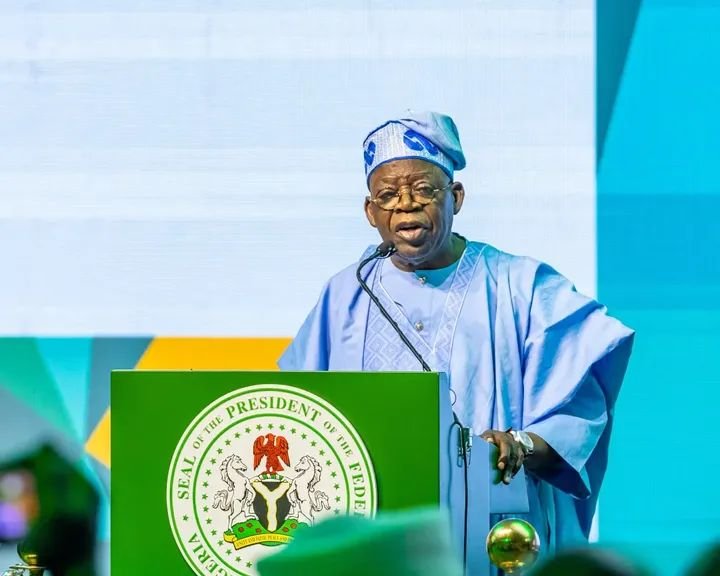
President Bola Tinubu has urged Nigerians to maintain the country’s unity despite their differences, stating that dialog is crucial to Nigeria’s survival as a united nation.
Tinubu, represented by the Senate’s Deputy President, Barau Jibrin, made the statement on Tuesday at the International Conference on Security and National Unity, which was organized by Jama’atu Izalatil Bid’ah Wa Iqamatus Sunnah in partnership with the Muslim World League.
The president stated that the administration was dedicated to addressing Nigeria’s security concerns and promoting world peace through cooperation with other countries.
Tinubu said, “Not only that, the government is determined to make sure that we remain united as a country, despite our differences, whatever the differences may be. We should talk and remain in this country and allow this country to remain a united nation, a united country.”
Tinubu said the conference was opportune given the world’s various security concerns and that its deliberations will help to establish long-term regional, continental, and global peace.
He also praised the Muslim World League for collaborating with JIBWIS and selecting Nigeria as the first country to hold the conference.
Prof Nentawe Yilwatda, National Chairman of the All Progressives Congress, advised political leaders against manipulating religion and ethnicity for political benefit, stating that such activities could deepen tensions and cause long-term damage to the country.
The APC chairman emphasized that Nigeria’s diversity should be a source of strength, not a source of division.
He emphasized that religious and ethnic differences should not undermine Nigerians’ shared humanity and destiny.
Yilwatda, who was displaced during the Bauchi crisis, stated that violence did not discriminate between Christians and Muslims, as everyone suffered.
“When violence comes, it does not ask whether you are a Christian or a Muslim before it destroys either your home, or your humanity, or your dignity,” he said.
He stated that his experience of living in an internally displaced persons’ camp had taught him that Nigerians could worship differently but still share the same fears, aspirations, and destiny.
“We may worship differently. Or we may suffer together. We dream together. We can build together. And ultimately, we can rise and fall together,” Yilwatda said.
The APC chairman called on politicians to resist the temptation to weaponize religion and ethnicity, warning that temporary political gains could result in permanent damage to the nation.
“To our political leaders, let us resist the temptation to exploit religion or ethnicity for sentiments and sentiments for temporary political advantage.
“No political victory is worth the permanent damage inflicted on our nation, and we’ve been seeing it every day,” he said.
Yilwatda also called on religious leaders to use their influence to promote peace and reconciliation, rather than hatred and division.
“You as religious leaders, let our mosques and our churches become centers of peace, of reconciliation, and of responsible citizenship,” he said.
He urged religious leaders to “preach faith without hatred, conviction without contempt, and truth without incitement,” while also encouraging traditional leadership to choose discourse and reconciliation over retaliation.
Yilwatda also urged religious and political leaders, traditional institutions, and citizens to work together to combat hate speech and safeguard vulnerable communities.
“We will not use religion to justify violence, and we will reject hate speeches wherever they come from—a pulpit, or a mosque, or the palace, or a political platform, or the keyboard of our social media,” he said.
He urged Nigerians to create a country in which people defend one another regardless of religious or ethnic origin, stating, “Not because we share the same faith or ethnicity, but because we share the same humanity.”
Yilwatda stated that Nigeria must choose peace and leave future generations with schools, homes, and opportunity rather than displacement camps and violent memories.
The Nigeria Inter-Religious Council also advised Nigerians to oppose attempts to use religion, ethnicity, and poverty to foment division, emphasizing that humanity remains the common tie among citizens.
Professor Cornelius Omonokhua, Executive Secretary of NIREC, stated that Christians and Muslims must preach mercy, compassion, love, and respect for human dignity.
Omonokhua said, “No one is created a Christian, and no one is created a Muslim. We are created as human beings; hence, what binds us together is humanity.”
He stated that religion must not be used to justify violence, noting that both Christianity and Islam uphold the sanctity of human life.
He added, “We should never allow anybody to weaponize religion or ethnicity or poverty to turn us against each other. May God give us security and may we continue to live in peace and harmony.”
The NIREC executive secretary stated that the council has continued to promote human dignity, the common good, and Nigerian welfare through Christian-Muslim cooperation.