




Anyone who has played online slots recently has probably seen a pop-up asking them to join a tournament. Most players click through without really understanding what the tournament actually does or how the prize gets awarded. That is unfortunate, because slots tournaments are one of the more interesting pieces of the modern online casino product.
A slots tournament turns a solo game into a competition. Players compete against each other on a leaderboard over a fixed time window, with the highest scorers taking cash prizes from a shared pool. Nothing about the underlying slot mechanics changes; what changes is that individual spins now contribute to a running competition alongside their normal payout behaviour.
The interesting parts of a tournament sit in the scoring, the prize pool, and the psychology. Once those are visible, the whole product category makes considerably more sense than it does when the pop-up first appears mid-session.
What a Slots Tournament Actually Is
A slots tournament is where players compete on a leaderboard by scoring points from real-money spins. Points come from the multiplier value of each win. A big multiplier hit contributes more than a small one, and the final leaderboard determines who wins from the prize pool.
Free tournaments are the most common format. The operator or the game supplier funds the prize pool and players opt in without any entry fee. UK operators offer free slots tournaments alongside their standard slot lobby as a regular part of the promotional calendar, with new tournaments starting daily or weekly across a rotating set of games.
The key mechanical difference from regular slot play is that a tournament creates a shared timeframe and a common metric across all participants. Solo slot play is completely independent from what other players are doing. Tournament play makes every spin part of a race, which changes how the session feels even though the underlying spin mechanics are identical.
How the Score Is Actually Calculated
Tournament scoring almost always uses multiplier wins as the point metric. A spin returning 20 times the bet contributes more than a spin returning twice the bet. The biggest single multiplier win of the tournament often carries disproportionate weight in the final leaderboard position.
The implementation varies by promotion. Business of iGaming’s Drops & Wins coverage describes Pragmatic Play’s network-wide promotion using accumulated multiplier sums. That promotion has distributed over $100 million since 2020, with Season 7 running through March 2027 on a $25 million pool.
The score does not depend on the total amount wagered directly. A player who bets small and lands a rare big multiplier can outscore a player who bets large but only lands small wins. That structure is what makes the tournament format genuinely competitive rather than just a spend-more-to-win-more mechanic.
Why Operators Give Free Tournaments Away
The obvious question is why any operator would give away money for free. The tournament is marketing spend, not a prize giveaway. Most opted-in players do not win, but they play more spins than they otherwise would, and the extra spins offset the prize cost.
The math works because slot house edge is durable. A tournament that gives away £10,000 in prizes but generates £200,000 of additional real-money wagering across all participants earns the operator (or the supplier funding the pool) roughly £8,000 in expected margin. The tournament effectively subsidises player engagement at a fraction of the equivalent advertising cost.
Provider-funded tournaments add another layer. When Pragmatic Play or another game supplier funds the pool directly, the operator gets the engagement uplift without paying for the prizes themselves. That shifts the economics further in the operator’s favour and explains why network-wide tournaments have grown so rapidly since 2020.
The Prize Pool Structure
Prize pools distribute across positions rather than being winner-takes-all. The typical structure across the industry looks like this:
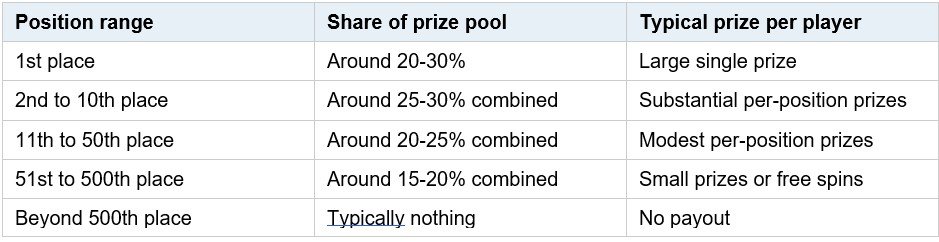
The top-heavy distribution matches what most competitive prize structures look like. It creates a clear headline prize for the marketing while distributing enough to a wider group to keep the tournament feeling winnable for the average player.
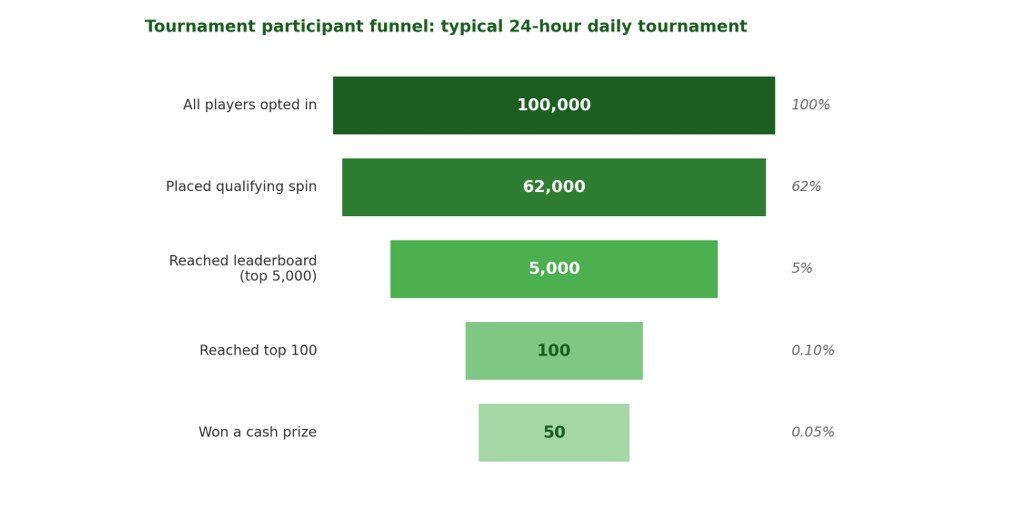
The realistic funnel from opt-in to prize winner is much steeper than most players realise. In a typical daily tournament, well under one percent of opted-in players end up with a cash prize. Only a fraction of a percent reaches a headline-worthy position.
How Tournaments Change the Slot Session
Regular slot play has no external time pressure. A player can start a session whenever they want, stop whenever they want, and take breaks between spins without any consequence beyond the slot’s own volatility patterns.
Tournament play changes that. The clock creates a defined session structure, and the leaderboard adds an ongoing feedback loop. Moving up a position keeps players spinning past when they might otherwise stop, and the format is deliberately designed to extend session length.
The behavioural shift is real but not universal. Some players engage seriously with the leaderboard, while others treat the tournament as background interest. Both patterns are legitimate; the format serves different customer segments differently.
Where Slots Tournaments Sit in the Modern Casino Product Mix
Slots tournaments have become a standard product feature at most modern online operators. Provider-funded prize pools, low implementation cost, and measurable engagement uplift make them reliable. The combination of these three factors explains why the format has spread so widely.
The trajectory looks stable. Pragmatic Play’s Drops & Wins is by far the largest network promotion, but Pragmatic Play is not the only supplier running network-wide tournaments. Play’n GO, NetEnt, and Yggdrasil all operate similar structures at varying scales, and the overall category is expanding rather than consolidating around a single provider.
For anyone playing slots at a modern operator, tournaments are worth understanding rather than dismissing. They will not turn losing sessions into winning ones. The odds of a headline prize are longer than the marketing suggests, but they add a genuine competitive layer to what is otherwise a solo game.