




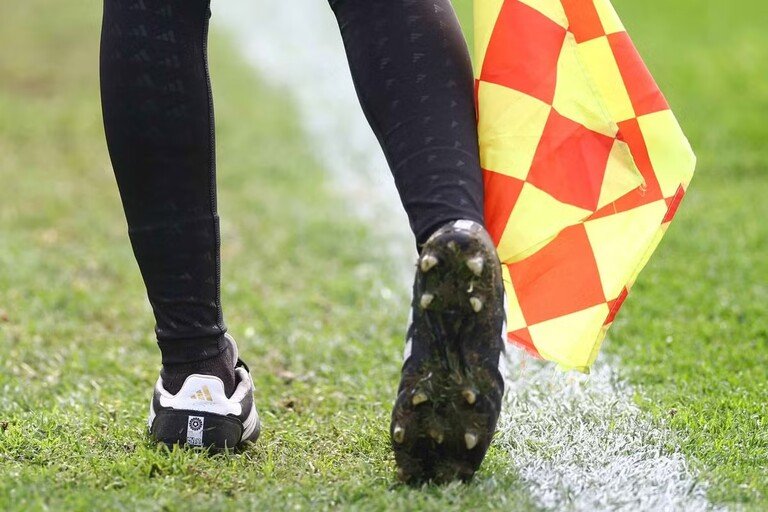
The delayed offside flag may soon be obsolete as FIFA introduced new technology for the 2026 World Cup.
FIFA is set to implement advanced semi-automated offside technology for video assistant referees (VAR), enhancing decision-making speed and allowing an assistant to raise the flag instead of waiting for a play to develop.
An immediate audio notification will be dispatched to the assistant if a player is over 10cm offside.
Earlier iterations of the technology used at the Club World Cup and the Intercontinental Cup only alerted officials if a player was more than 50 cm offside.
The official will be responsible for deciding when to raise the flag and stop the game. They can lower the flag if they believe a malfunction has occurred, but FIFA states that the technology includes several failsafe measures to avoid errors.
The technology will remain incapable of identifying the nearest offsides, and there are restrictions when players are on the ground or when several are too closely positioned.
It is solely applicable for positional offside and not for subjective decisions, which involve interpretation regarding whether a player has interfered with an opponent without making contact with the ball.
FIFA aims to alleviate some of the irritation experienced by fans and players while also minimizing injury risks caused by unnecessary gameplay when an offside call is imminent.
In May 2025, Nottingham Forest forward Taiwo Awoniyi was put into an induced coma following a collision with a post caused by the assistant’s delayed offside flag.
FIFA also announced that realistic, AI-driven 3D avatars of all players will be generated to enhance decision-making accuracy.
This will involve producing a digital scan of every one of the 1,248 athletes in the 26-member rosters of the 48 teams.
Every player will step into a chamber for scanning, a procedure that will take only one second and only needs to occur once during their pre-tournament photo session.
Consequently, improved and more distinct offside animations will be implemented at the World Cup.
FIFA has also sanctioned the use of technology that can identify whether the ball exited the field prior to a goal being made.
In February, Aston Villa saw a goal ruled out against Brentford under questionable circumstances as it was uncertain whether the ball had crossed the line.
A 3D animation will be developed, similar to goalline technology, that can display the precise position of the ball.
The chip embedded in the ball will show which player last made contact, allowing the VAR to verify whether a corner was the right call under new authorities.
FIFA has additionally broadened ‘Real-time 3D Recreation’ to enhance ‘line-of-sight’ decisions for offsides, making them faster and more transparent.
Two virtual feeds are accessible to the VAR and television audience, reflecting the views of each goalkeeper.
This season, there were numerous ‘line-of-sight’ offside situations that raised doubts about whether the goalkeeper’s visibility was affected. This aims to provide the VAR with an additional resource to make that choice.