

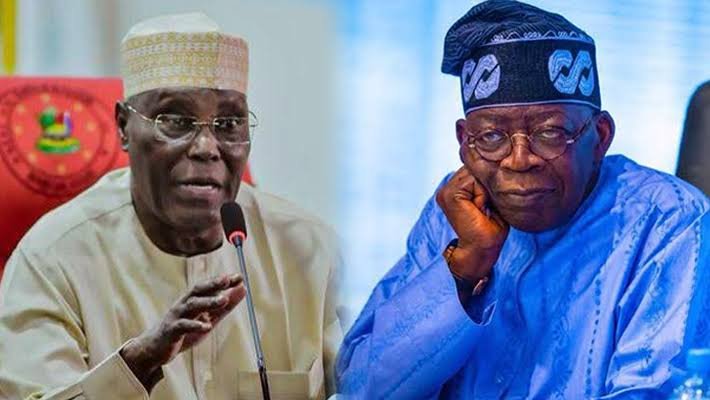
The presidential candidate of the African Democratic Congress, Atiku Abubakar, has told President Bola Tinubu that his time is up, declaring that “the era of political complacency, propaganda, and governance by deception is drawing to a close” and that Nigerians are preparing to reclaim their country through the power of the ballot.
“The era of excuses is ending. The era of accountability is approaching. The era of propaganda is fading. And with the support of Nigerians, a new chapter of competence, prosperity, security, and genuine hope shall begin.
“Let no one be deceived. The era of complacency is over. The era of propaganda is ending. The era of taking Nigerians for granted is coming to a close. The people are awake. The people are watching. And when the time comes, they will deliver their verdict through the ballot,” he said on Friday in a statement by his Senior Special Assistant on Public Communication, Phrank Shaibu.
Criticizing the president directly as his administration marks its third anniversary in office, Atiku said the most fitting report card of the Tinubu years is not the glossy advertisements, expensive media campaigns, or self-congratulatory speeches emanating from Abuja, but the tears of hungry families, the despair of unemployed youths, the collapse of businesses, and the haunting images of schoolchildren being abducted by criminals while a complacent government looks the other way.
According to the former vice president, while every government is entitled to its own opinions, no government is entitled to its own facts.
“Three years ago, President Tinubu promised renewed hope. What Nigerians have received instead is renewed hardship, renewed insecurity, renewed poverty, and renewed hopelessness,” Atiku said.
He noted that food prices have skyrocketed beyond the reach of ordinary families, inflation has become a cruel tax on the poor, small and medium-scale businesses are shutting their doors, the naira has been battered, and purchasing power has collapsed.
Atiku also berated what he called reckless borrowing without accountability, citing public reports indicating that while the Federal Government borrowed approximately N11.9 trillion within a nine-month period, only N3.1 trillion was reportedly spent on capital projects.
“Nigerians are therefore entitled to ask a simple question: where did the rest of the money go?” he asked.
He also expressed concerns about the concentration of infrastructure contracts, noting that a significant portion of publicly highlighted spending appears to be directed at the Lagos-Calabar Coastal Highway and the Badagry-Sokoto Highway, both of which were reportedly awarded to a company owned by a businessman whom President Tinubu publicly described as his “partner in daring.”
“This administration has created the disturbing perception that while ordinary Nigerians are being asked to endure sacrifice, the benefits of government spending are increasingly flowing towards a privileged circle of politically connected interests,” Atiku said.
The former vice president characterized the resumption of mass abductions as the most damning indictment of Tinubu’s three years in office.
He referenced the recent abduction of schoolchildren in Borno State, as well as the widespread kidnapping of students and teachers in Oyo State’s Oriire Local Government Area, as examples of a government out of touch with reality.
“The tragedy of Borno and Oyo is not merely a security failure. It is the inevitable consequence of a government that has become detached from reality and addicted to propaganda,” he added.
Atiku rejected government claims of economic and security progress as carefully curated narratives designed to create the illusion of improvement where none exists.
Atiku warned those in authority not to mistake Nigerians’ patience for everlasting acceptance, claiming there is a clear distinction between endurance and approbation.
The former vice president promised that the ADC would present a detailed policy framework in the next weeks, addressing economic recovery, job creation, security sector reform, fiscal control, healthcare expansion, and restoring public trust in government institutions.