



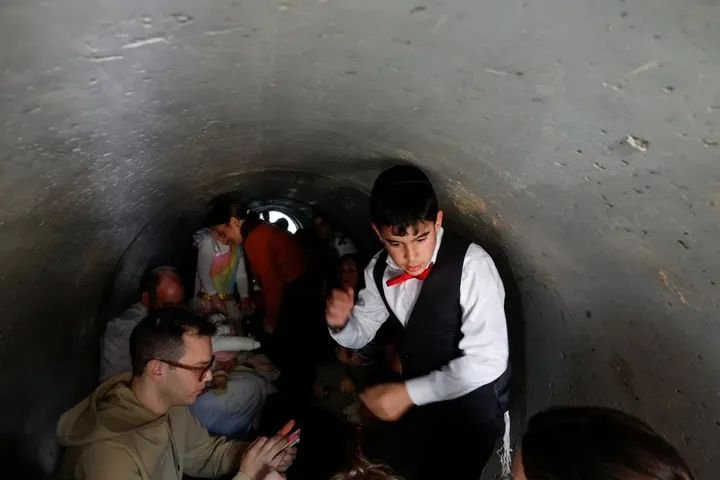
The US–Iran war escalated sharply on Thursday after Iran launched a fresh wave of missiles at Israel, forcing millions of residents into bomb shelters as the conflict entered its sixth day.
Air raid sirens sounded across Israel in the early hours of Thursday following the missile barrage from Tehran, marking one of the most intense exchanges since hostilities began between the United States, Israel and Iran.
The escalation came only hours after the U.S. Senate rejected an attempt to curb the White House’s war powers.
Lawmakers voted 53 to 47 against advancing a resolution that would have halted the U.S. air assault on Iran unless authorised by Congress. The vote fell largely along party lines, with nearly all Republicans opposing the measure and most Democrats supporting it.
The decision leaves Donald Trump with broad authority to continue directing the military campaign.
Conflict widens across the region
The conflict is rapidly spreading beyond Iran and Israel.
On Wednesday, a US submarine sank an Iranian warship off the coast of Sri Lanka, killing at least 80 people, according to reports.
At the same time, NATO air defence systems intercepted and destroyed an Iranian ballistic missile fired toward Turkey, marking the first time the NATO member has been directly drawn into the war.
However, US Defence Secretary Pete Hegseth said the incident was not expected to trigger NATO’s collective defence clause.
Oil routes disrupted
The fighting has also paralysed shipping through the strategic Strait of Hormuz, one of the world’s most important oil and gas routes.
More than 200 vessels are currently anchored offshore as companies halt voyages due to security risks, according to estimates.
The US government has pledged to provide naval escorts and insurance for commercial tankers once military resources become available.
Energy Secretary Chris Wright said the US Navy would escort oil tankers through the strait “as soon as it can”, but added that current operations remain focused on the war effort.
Global markets react
Financial markets showed signs of recovery after days of losses.
Asian stocks rose on Thursday, while U.S. markets closed higher the previous day amid speculation the conflict could eventually de-escalate.
Some traders cited a report suggesting Iranian intelligence had reached out to the CIA early in the conflict about a possible path to ending the war. However, Iranian officials dismissed the claim as “psychological warfare”.
Kristalina Georgieva, Managing Director of the International Monetary Fund, warned the war could have severe economic consequences.
“If proven to be prolonged, it could affect global energy prices, market sentiment, growth and inflation,” she said.
Khamenei funeral postponed
Meanwhile, uncertainty surrounds the funeral of Iran’s late supreme leader Ali Khamenei, who was killed in an Israeli air strike on Saturday.
Iran had planned three days of public mourning in Tehran, but authorities have now postponed the ceremonies indefinitely and have not announced a new funeral date.
Attention has turned to the succession process.
Iran’s Assembly of Experts is expected to soon select the next supreme leader only the second such transition since the Islamic Republic was founded in 1979.
Among the leading contenders is Mojtaba Khamenei, the son of the slain leader, while Hassan Khomeini, grandson of revolutionary founder Ruhollah Khomeini, is also considered a potential candidate.
Israel has warned it will target whoever becomes Iran’s next supreme leader, signalling that the war could intensify further.