



An Economic and Financial Crimes Commission (EFCC) investigator has told the Federal Capital Territory (FCT) High Court in Abuja that commercial banks hoarded newly redesigned naira notes during the controversial currency swap that plunged Nigeria into severe cash scarcity.
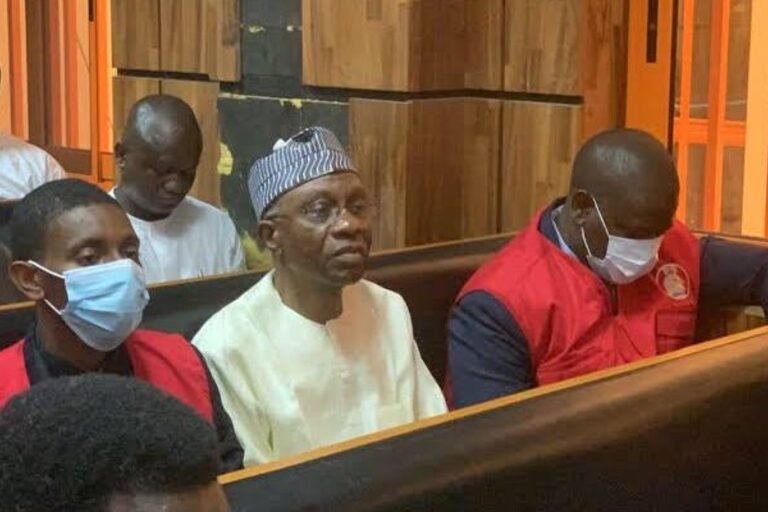
Testifying on Tuesday, Chinedu Eneanya, the seventh prosecution witness in the trial of former Central Bank of Nigeria (CBN) governor Godwin Emefiele, confirmed that bank officials committed infractions, including the hoarding of currency notes, during the naira redesign exercise between late 2022 and early 2023.
However, the investigator admitted under cross-examination that he could not remember the total number of banks involved or whether any officials were arrested.
“I am aware of that, but I cannot be specific,” Eneanya told the court when asked by Emefiele’s lawyer, Olalekan Ojo (SAN), to confirm whether banks hoarded the new notes.
The EFCC is prosecuting Emefiele on four counts bordering on illegal redesign of the naira, disobedience to lawful directives and acts allegedly causing hardship to Nigerians.
Defence questions EFCC’s handling of banks
During proceedings, Emefiele’s lawyer pressed the EFCC witness on whether bank officials found hoarding cash were arrested or sanctioned.
The prosecution objected, arguing that the witness’s assignment was limited to investigating whether the naira redesign had valid approval.
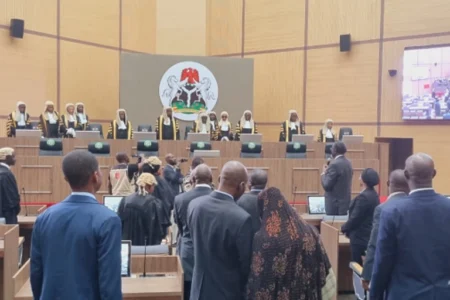
But the presiding judge, Maryann Anenih, overruled the objection and directed the witness to respond.
Eneanya admitted he was unaware of any arrests, stating that while the EFCC raised a task force to inspect banks nationwide, he was “not privy” to decisions taken against offending officials.
He also said he did not know who authorised the EFCC’s visits to commercial banks during the cash crisis.
Requests for documents and adjournment
Emefiele’s defence team requested that all investigative records, stock-taking reports and documents relating to cash distribution to banks be made available.
The court subsequently adjourned the case to 19 March for the continuation of cross-examination.
Emails, Mint role and contradictions
Earlier, the witness told the court that the Managing Director of the Nigerian Security Printing and Minting Plc (NSPM), Ahmed Halilu, provided email communications between the Mint and UK-based firm De La Rue, which was engaged to redesign the naira notes.
Eneanya said the emails were opened in the presence of EFCC investigators but admitted he could not recall all the statements made by Halilu.
Under questioning, the EFCC witness also struggled to recall whether the Mint had ever designed naira notes in the past, the quantity of currency supplied to banks, or whether EFCC teams checked bank vaults nationwide.
Background to the naira redesign trial
The naira redesign policy saw the CBN withdraw old ₦200, ₦500 and ₦1,000 notes from circulation and replace them with new versions, triggering months of acute cash shortages, protests and economic disruption.
Previous witnesses told the court that former President Muhammadu Buhari approved the redesign on the condition that the notes be produced locally and that the CBN board was not consulted before implementation.
Emefiele has denied all charges.