



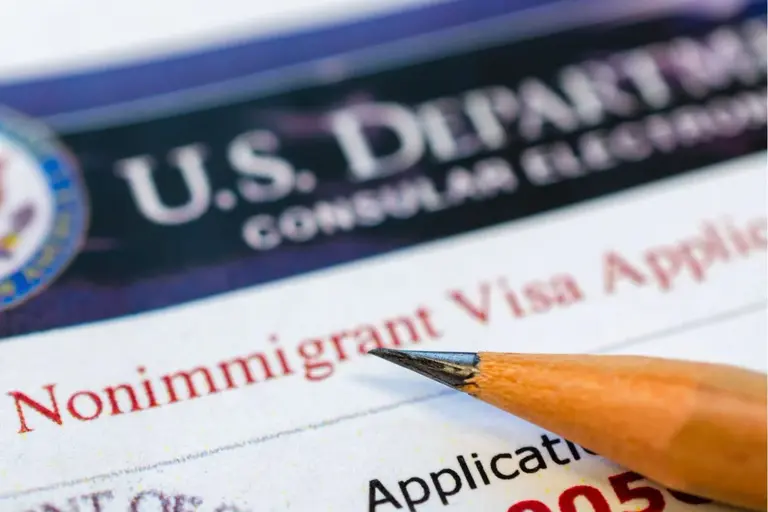
Tension is rising across Nigeria’s aviation and travel industry as the United States prepares to enforce new visa restrictions on Nigerian nationals from 1 January 2026 — a move experts say could sharply reduce passenger traffic on Nigeria–US routes.
The measures, which affect both immigrant and non-immigrant visas, have already unsettled intending travellers. Airlines and travel operators warn that fewer approvals and longer processing timelines will weaken demand for transatlantic flights, placing pressure on route viability.
Currently, only two US carriers operate direct scheduled flights into Nigeria — United Airlines and Delta Air Lines. Together, they run 17 weekly flights between Nigeria and the US and carried a combined 207,340 passengers in 2024, according to figures from the Nigeria Civil Aviation Authority (NCAA).
Delta Air Lines accounts for the bulk of this traffic, operating 14 weekly flights on the Lagos–Atlanta and Lagos–New York routes. The airline transported about 160,399 passengers last year. United Airlines operates three weekly flights from Washington Dulles to Lagos, carrying 47,340 passengers in 2024.
Industry stakeholders fear these numbers could drop significantly once the visa restrictions take effect.
Gbenga Onitilo, Managing Director of Travelden, a subsidiary of Finchglow Holdings, said the policy would inevitably ripple through airlines operating direct US–Nigeria services. He noted that visa uncertainty and elongated processing cycles would reduce passenger load factors and weaken route economics.
“Transatlantic flights are capital-intensive and depend on strong, predictable demand — particularly from business travellers, students and the diaspora,” Onitilo said. “Any sustained drop could force airlines to rethink frequencies, aircraft deployment or even long-term route sustainability.”
He added that the visa decision highlights deeper diplomatic issues now spilling into commercial air travel and cross-border mobility. Drawing comparisons with Mali, which recently faced similar US sanctions, Onitilo said the West African country adopted a firm but strategic response — combining reciprocal visa measures with technical fixes around identity verification and repatriation — leading to the lifting of restrictions.
“Visa sanctions are not resolved by outrage or silence,” he said. “They are lifted through coherent diplomacy, reciprocal signalling and fixing the trigger points.”
Onitilo argued that despite Nigeria’s market size and strategic importance, weak diplomatic coordination continues to translate into economic losses.
Echoing similar concerns, Olumide Ohunayo, Director of Research at Zenith Travels, said Nigerian interests would be the biggest casualty of the restrictions. He noted that foreign airlines would face less pressure due to their broader networks, while Nigeria currently has no local carrier flying to the US.
“The immediate effect will be fewer passengers travelling to the US,” Ohunayo said. “That means lower aviation sector contribution to GDP and serious financial strain for travel agencies.”
He stressed that retaliation was not the solution, urging diplomatic engagement instead. “If countries like Ghana are engaging the US and avoiding this backlash, Nigeria can do the same,” he said.
The US government is set to begin a partial suspension of visa issuance to Nigerians under Presidential Proclamation 10998, aimed at strengthening border and national security. Nigeria is one of 19 countries affected by the measure, which takes effect at 12:01 a.m. Eastern Standard Time on 1 January 2026.